Friday, February 01, 2008

Camera Trap Setup Part 2

Well no luck.....the only thing I had was the rear end of a deer. But I'm not giving up so I setup my FurFindr and rebaited the site with another good dose of fox urine and beaver castoreum. The FurFindr is a really cool tool which produces short sound bites of four different animals: a bird, fox, rabbit, and a rodent. Each bite plays for 5 seconds and then repeats every 30 seconds. An electronic light sensitive eye located on the outside of the unit allows it to play only at night when predators are most active. They say a human can hear it 300 yards away, so a fox with its superior hearing should be able to hear it even further. The FurFindr should pull them in and then the lures should hold them there in front of the camera long enough to get some photos. I set it this time to the rabbit squeal to see what happens.
Afterwards I went exploring and came across what would be a perfect denning area. The entrance hole was underneath an old root and appeared to have been dug towards and underneath the stump from which it had originated. I wanted to set up a camera nearby, but it is right on the edge of a trail and would leave it exposed to anyone who walked past it. I've already had one camera pilfered so I'm at odds at what to do with such a perfect opportunity. I'm thinking about spreading out a smooth area of sand near the entrance to act as a "track trap" to see if anything is using it as a den.

Labels: , , ,

Wednesday, January 16, 2008

Camera Trap Setup Part 1

The deed is done….I’ve finally got around to setting up a camera trap….let the games begin! The main reason for setting up this camera is to capture images of a gray fox. The gray fox, to me, is one of the most beautiful and fascinating animals I’ve ever come to know. My first encounter happened while hiking back in August 2006 in Roosevelt, TX. I had been hiking when all of a sudden I had that feeling that something was watching me. As I turned around there it was sitting in the middle of the road. What a sight! There’s no doubt they’re in this area due to all of the tracks and scat that I’ve come across.
In fact, not far from the area where I setup the camera trap I found muddied tracks of one that had crossed a wooden bridge that goes over a thin watercourse that originates from the creek. And unfortunately on my way up here I found one that was road-killed about five miles away. The spot I chose for the camera was about 60 yards off of the trail. I could see the paths of animals that had been traveling through this location from different angles. Also nearby was a log that had been used by a bobcat as a scratching post.
I did what Camera Trap Codger did and mounted two 2”x2” carpet squares to a log that was directly in front of the camera. I then saturated them with fox urine and beaver castoreum. The fox urine lure was so pungent it made my nose run, and the beaver castoreum lure, well to quote the Codger “So fine a scent! I jest not. Castoreum has a sweet tarry essence.” Not a bad smell considering it came from a beaver gland. I didn’t set up my FurFindr this time, but if nothing turns up when I come back in a week or so I’ll then add it to the mix. Wish me luck!

Labels: , , ,

Wednesday, January 31, 2007

Gray Fox Kill Site??

dove attack_kill site
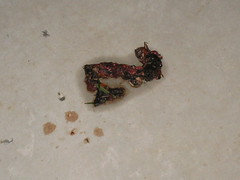
My brother came across a kill site in his open garage at his camp that consisted of the remains of a dove. He figured that a neighborhood cat was the predator, but if you look at the scat that was left behind it contains fruit. Cats, whether it be a feral cat or wild cat (e.g. bobcat) normally do not have fruit in their scats.

dove attack_scat
Usually when you find a scat that contains fruit it is from a fox. The area where his camp is located is prime habitat for the gray fox and this is what I believe caught and ate the dove. The gray fox is omnivorous, meaning that it feeds on animal and vegetable foods such as fruits, rodents (voles, mice, shrews), birds, insects, eggs, rabbits, nuts, grains.

Labels:

Tuesday, January 16, 2007

To Gnaw


I came across a large bone on the forest floor which was probably left by a predator such as a fox or coyote that had either killed the animal it belonged to or had confiscated it from a kill site. Upon closer examination I discovered fine lines all along it edges. These lines were the cut marks left behind by the teeth of some sort of rodent. Bones, along with the shed antlers of deer, are loaded with calcium and phosphorous and are eaten by rodents such as mice, rats, and squirrels for these minerals. That's why deer sheds are so hard to find. Also, rodents have only one set of chisel-shaped teeth their entire lives, which continue to grow. They must gnaw on something hard in order to keep them sharp and to provide wear to prevent overgrowth. An interesting find. Click on pic for closer view. By the way....the word rodent originated from the Latin verb rodere- meaning to gnaw.

Labels: , , ,

Thursday, August 10, 2006

Watching the Watcher


I spent the last four days in Roosevelt, TX a small town in Kimble County with a sparse population of about 150 people. Friends of mine were headed here to work on their deer lease and asked me to come along knowing of my interests in nature. I roamed the countryside which was much different than my area of Texas in that it is a rougher type of terrain. Made up mostly of pinyon pines, junipers, cactus, some oaks and lots of scrub and rocks it is the perfect setting for finding rattlesnakes, but much to my displeasure I did not see a single one. I'm sure this was due to the intense afternoon heat. Though snakes are cold-blooded and enjoy the warmth of the sun they're smart enough to know when it is just too hot to be out. As I observed brown towhees rustling through leaf litter for bugs, jack rabbits fleeing my presence, and axis deer feeding in the open vistas little did I know that the watcher was being watched. After hiking several miles I decided to turn back and when I did, there behind me, sitting in the road 50 yards away was a gray fox (Urocyan cinereoargenteus). I immediately froze in my tracks not believing my good fortune. Foxes are very secretive animals and normally hard to spot. I had found its scat in many areas along my trek, but thought my chances of seeing one was remote. And now one had come to me. It was probably hidden in the brush watching as I unknowingly walked past it and then being the curious animal that it is, came out to see what I was up to. Luckily I had my camera around my neck and not in my backpack and slowly raised it to capture the photo presented in this post. I took a few more photos, mainly of its backend as it departed as deftly as it had appeared. Encounters such as this are what drive me to spend as much time as possible outdoors. It's the never knowing of what you're going to find around the next corner, under the next rock or log, or right behind you.

Labels: ,

Web Counter
Online Schools