Friday, June 22, 2012

Unusual Cooper's Hawk Behavior


I came across an interesting post by a subscriber on the BIRDCHAT Listserv that spoke of an observation he made of a Cooper’s hawk that had captured a Ring-billed gull and then drowned it by holding it underwater. I’ve read about lots of different bird behavior, but this one came as a surprise. I've seen the outcome of shrike impalement, birds pummeling their quarry against a hard surface, hawks utilizing their tomial tooth to severe spines, but this is the first time I've come across "drowning" as a bird's methodology of dispatching prey. Incidentally, why didn’t the hawk use its tomial tooth instead? I found this rather interesting and decided to look into it further and found that this isn’t the first time this behavior had been observed and documented. Check out the videos I found of a hawk drowning a magpie and one drowning a pigeon in a swimming pool.


Suggested Reading:


1) "Death By Drowning: One Cooper’s Hawk Approach"

2) "Cooper’s Hawk “Drowning” Its Prey"

3) "Unusual Behavior of a Cooper's Hawk"


Labels: , , , , ,

Tuesday, January 19, 2010

Butcher Bird

"Saw a shrike pecking to pieces a small bird, apparently a snowbird. At length he took him up in his bill, almost half as big as himself, and flew slowly off with his prey dangling from his beak. I find that I had not associated such actions with my idea of birds. It was not birdlike."

Henry David Thoreau Dec. 24 1850


I came across my first shrike larder about ten years ago as I walked a long a span of barbed wire that bordered a sprawling cow pasture. To tell you the truth at the time I had no idea what I had come across. I began thinking I had discovered the morbid collection of some weird cult.


A bird of mostly open country this passerine raptor at first glimpse resembles a miniature mockingbird with the bill of a hawk. It’s our only predatory songbird, is diurnal, very aggressive and bold for its miniature stature. It does most of its hunting from elevated perches, most times along power lines making use of its phenomenal vision to spot the tiniest of prey. I’ve seen them dive from 40-50 foot perches to the ground to seize something as miniscule as a cricket. Their feet are powerful for grabbing prey, but lack the large flesh piercing talons of raptors (e.g. hawks, eagles, etc). The tip of its upper bill is hooked and has a feature near the tip known as a “tomial tooth”. It's this tooth the shrike uses to dispatch large prey (birds, small mammals, etc.) by biting through the vertebra of the neck, severing the spinal column. Prey selection is mostly insects, small mice, reptiles and amphibians, but it also will take small birds on the wing. Sometimes birds twice their size. I once spotted one in an oak tree with a magnolia warbler in its talons. What’s really interesting about these birds is their caching behavior, which involves the gruesome task of impaling prey, which by the way paved the way to its nickname “butcher bird”.


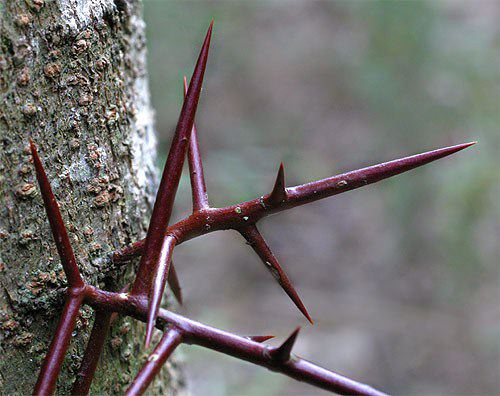
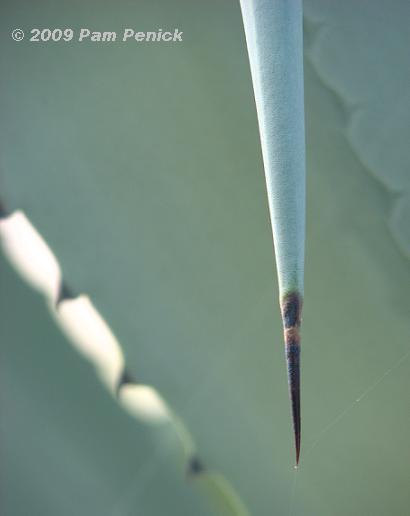
They have been reported using several types of impaling substrate such as:

Honey locust thorns
Barbed wire
Blackbrush thorns
Agave plant spines
Hawthorn
Yucca
Saguaro spines
Hercules' club thorns
Sharp tree stems
Will also sometimes wedge prey in narrow branch forks


So why do they perform this ghastly act? Here's a list of possible uses of a cache or "larder":

1) Food hoarding for times of prey shortage or increased food demand (e.g. during nesting season to supplement prey brought to nestlings), during periods of stress and/or inclement weather. (1), (2), (3).

2) Impalement used to aid in food manipulation (food tearing) due to lack of talon strength. (2)

3) Large larders could impress females, which may offer some indication of the male's hunting prowess and ability to supply food. It was found there was a higher reproductive success in males with larger larders. (2), (3)

4) Used as a method of marking territory ownership and boundaries. (2), (3)

5) Chemically defended prey (e.g. monarch butterflies, lubber grasshoppers, eastern narrow-mouthed frog.) are impaled enabling toxins to degrade and allowing these to be used as food sources. (2), (3), (4), (5) .

6) Used to feed female to conserve energy during brooding. (6)


Several years back I surveyed a number of birders asking of their experiences with larder finds and observations of shrikes taking prey. Here's what I got:

Birds seen captured or impaled:

Carolina chickadee, English sparrow, Field sparrow, Northern Cardinal, Cedar waxwing, Bewick’s wren, Chimney swift, Cassin’s vireo, Ruby-crowned kinglet, Pine siskin, Chipping sparrow, American goldfinch, Painted bunting, Grey gnatcatcher, Black-capped chickadee, Yellow-rumped warbler, Ruby-throated hummingbird, Eastern phoebe, Chestnut-sided warbler, Indigo bunting, Downy woodpecker, Summer tanager, Wilson’s warbler (see photo impaled on yucca- courtesy of Brush Freeman), Tennessee warbler, House finch, Mourning dove, Red-eyed vireo, Savannah sparrow, Cerulean warbler, Broad-tailed hummingbird, Goldfinch, Bluebird, Eastern meadowlark, Mockingbird, Vermillion flycatcher, Red-bellied woodpecker, Hairy woodpeckers, American robin, Prothonotary warbler, Dark-eyed junco, European starling, White-crowned sparrow, Henslow sparrow, Inca dove, Common redpoll, Barn swallow, Virginia rail, Dunlin (northern shrike), Grasshopper sparrow, Harris’ sparrow, Zebra finch (pet store escapee), Lincoln’s sparrow, Pyrrhuloxia, Slate-colored junco, Gambel’s quail (juvenile).


Insects found impaled:

Grasshoppers, Crickets, Moths, Caterpillars, Cattle ticks (witness saw shrike removing them from a cow and then impaling them on barbed wire) (8) , Cicadas, Bees, Wasps, Beetles.


Other items found impaled:

Field mice, bats(see photo courtesy Of David Sarkozi), Northern leopard frog, crawfish, turtles, spiders, 13-lined ground squirrel (Toronto, Ontario), Lizards, Skinks, Green anoles.


Other interesting tidbits of shrike lore:

~ I had someone tell me they had seen one on the Texas coast near a wooded area where migrating passerines stopped to eat and rest following their long trip across the Gulf of Mexico. It was hypothesized that it was taking advantage of and attacking tired migrating birds.

~ They’ve also been known to impale inedible items such as fecal sacs, paper wasp nests, wool, eggshells, and snail shells. (3). They have been seen impaling twine on a barbed wire fence aiding them in breaking it into smaller pieces for nest construction. (3)

~ It is also known as French mockingbird by some.

~ A birdbander reported seeing a shrike attack a banded bird following its release. (7)

~ A group of shrikes is known as a "watch" of shrikes.

~ Chippewa Indians called this bird "big cannibal bird".

~ "Audubon (1842) quotes the Rev. John Bachman as saying: "I have seen one [shrike] occupy himself for hours in sticking up [on thorns]....a number of small fishes that the fishermen had thrown on the shore....." (8)

~ "Carrion is sometimes eaten. Prof. F.E.L. Beal while at Ames, Iowa, in January, 1880, saw a butcherbird fly over the brown frozen prairie to a carcass of a cow, where it lit on one of the ribs and greedily tore off shreds of the flesh." (8)

Labels: , , , , , , ,

Thursday, February 14, 2013

Pirate Bird

In the spring of 2012 I made a trip to Sabine Pass to check on migrants, hoping to catch a nice fallout, when I happened upon a Crested Caracara (Caracara cheriway) on the edges Hwy 87.   A bird of prairies, grasslands, and pastures, it was perched atop the bare branches of a tallow tree. It probably had been touring the highway for easy roadkill and decided to take a break upon this reviled invasive tree. It wasn't a restful break that's for sure, because a mockingbird was mobbing it for all it was worth.   Soon blue jays and grackles joined in on the fray.  It sat there in all its glory, ignoring the mobbers as if they didn't exist.......meaningless confetti. 
It’s also known as Audubon’s Caracara, King of Vultures, Caracara eagle, Common caracara, and King buzzard, and in Mexico it is known as a Mexican eagle or Mexican buzzard. Like the falcons they are related to they possess a "tomial tooth"on the upper mandible providing them with an effective means of dispatching live prey by the severing of its captive’s spinal cord. 

This bird is odd looking to say the least with its chicken-like legs and odd looking head.  I recall someone once saying that it looked as if it had an unruly toupee upon its head. In the book “Birds of America” I found this quote- “Perched upright in the cactus or mesquite, with a strange grandfatherly appearance, or flying slowly with stiff outstretched neck, Audubon’s Caracara strikes the observer with singular grotesqueness.”  Strange looks aside, it is a wily creature and like most other breathing animals on this great blue planet it will do whatever it takes to survive and flourish.

Though it is considered a predator they are opportunistic feeders and scavengers, usually hanging around with the likes of roadside carrion eaters such as black and turkey vultures and it never passes up an opportunity to steal or "pirate" food if the occasion presents itself. They’re  even so bold as to harass bald eagles and osprey (18) on the wing in an attempt to get them to drop prey they possess in their talons. They've also been seen attacking brown pelicans with pouches filled with fish, causing them to disgorge so that they could get it for themselves. The Texas naturalist Roy Bedichek in his book Adventures with a Texas Naturalist said "...he is a porch-climber and a thief, and the name "eagle" is a misnomer." Obtaining prey also comes by other means- They have been seen taking advantage of leftovers "at hen houses, slaughterhouses and garbage dumps." (2)There have been instances noted where they actually watched nesting songbirds as they went about their duties of hunting and feeding their young and then in turn went looking for their nests. Observers actually witnessed them raiding the nests of loggerhead shrikes and mockingbirds, in both instances leaving with a nestling or nestlings in its bill. (1) They have also been observed following tractors that were plowing fields and taking grasshoppers and small mammals that had been killed by the plow. (2) Their legs and claws are adapted for walking and running allowing them to actually chase down evading prey. 

Being opportunists the list of food items is endless which includes carrion, rabbits, other birds (16) (17), young of other birds, skunks, prairie dogs, opossums, mice, rats, squirrels, snakes (15) (19), turtles and their eggs, crabs, lizards, young alligators, frogs, crayfish, fish, insects and their larvae, earthworms, spiders, scorpions.


I canvassed the internet for crested caracara lore and found the following:


~ observed "shredding" cow patties in search of dung beetles (8) 
~ observed pursuing an American kestrel (6)
~ observed "taking" a Rhode Island Red rooster from someones barn. (7)
~ like other raptors they like wildfires- they will either wait at the fires edge keeping an eye out for escapees or they'll wait until the fire burns out and then scrounge for what didn’t escape. (5)
~ a group of four caracaras were observed attacking and killing Franklin gulls (10) and Golden Plovers (11).
~ a cattle rancher reported that caracaras were killing and eating his newborn calves (12).
~an observation in Bent’s Life Histories noted its liking of turtles- “Mr. Grimes sent me a photograph showing the shells of 43 mud turtles and a box tortoise, (and) the head of a large snapping turtle, a small garfish, and the remains of a bass that he picked up in a few minutes around a caracara’s nest that held large young.”  “At a distance of 100 feet I could plainly hear the bird’s mandibles clack against the turtle’s shell, as she held it down with her feet and strained and pulled at what it contained.” (14)  Also turtle eggs- I came across Jamie Felton's photostream on Flickr that contained nice photos of a pair of caracaras consuming eggs that had just been laid by a soft-shelled turtle. (13)

~ Also in Bent’s were details of them hunting in pairs- “One was hidden behind a tussock of grass while the other danced before a young lamb, trying to lead it from the place where its mother was grazing to where its companion was hidden.”  (14)

 ~ someone noticed what appeared to be a growth on the breast of a caracara. Turns out it was just its crop that was distended due to being full after the bird gorged itself.   This has also has been noted in black and turkey vultures (7) and in Harris and Red-tailed hawks. (4)
~ a caracara was observed chasing and harassing a turkey vulture forcing it to regurgitate food it had just eaten. The caracara then landed and ate this....yum. (9)
~ a group of caracaras were observed attacking and pursuing cattle egrets. (3)

An odd, but truly interesting bird to say the least. 


Photo of Crested Caracara with "bulging" crop courtesy of Greg Lavaty
Photo of Crested Caracara pair feeding on coachwhip snake courtesy of Greg Lasley
Photo of Crested Caracara with fish in mouth courtesy of Jamie Felton (photo does not have Creative Commons License)  

References and Suggested Reading:


(10) Caracara killing gulls

Share

Labels: , , , ,

Web Counter
Online Schools