Friday, June 22, 2012

Unusual Cooper's Hawk Behavior


I came across an interesting post by a subscriber on the BIRDCHAT Listserv that spoke of an observation he made of a Cooper’s hawk that had captured a Ring-billed gull and then drowned it by holding it underwater. I’ve read about lots of different bird behavior, but this one came as a surprise. I've seen the outcome of shrike impalement, birds pummeling their quarry against a hard surface, hawks utilizing their tomial tooth to severe spines, but this is the first time I've come across "drowning" as a bird's methodology of dispatching prey. Incidentally, why didn’t the hawk use its tomial tooth instead? I found this rather interesting and decided to look into it further and found that this isn’t the first time this behavior had been observed and documented. Check out the videos I found of a hawk drowning a magpie and one drowning a pigeon in a swimming pool.


Suggested Reading:


1) "Death By Drowning: One Cooper’s Hawk Approach"

2) "Cooper’s Hawk “Drowning” Its Prey"

3) "Unusual Behavior of a Cooper's Hawk"


Labels: , , , , ,

Tuesday, May 31, 2011

Cool Shrike Videos

Wednesday, December 15, 2010

Front Porch Ramblings

While out on the front porch of our camp enjoying a nice cigar (Acid Maduro, if anyone is interested), a red-headed woodpecker came my way landing in the ash tree that resides out front. It's probably one of the pair that hang around here. Red-heads are less likely to peck for insects as with other woodpeckers and instead, most times, prefers to flycatch for them much like bluebirds do from a perch. This is a striking bird and has acquired many other names do to its colors: patriotic bird, shirt-tail bird, jelly coat, flag bird, tri-colored woodpecker.

They're omnivorous meaning their diet varies greatly consisting of fruits, vegetables, seeds, acorns, insects, to even the eggs and young of other birds. It is also a caches food, hiding insects, sometimes live, and seeds under bark, in cracks, and even under the shingles of roofs for winter use. This woodpecker was once vilified due to its supposed damage to fruit crops and the eggs and young of other birds. Audubon didn't talk to kindly of this woodpecker as evident in a quote from Cleveland Bent's Life Histories of North American Woodpeckers:

"I would not recommend to anyone to trust their fruit to the red-heads; for they not only feed on all kinds as they ripen, but destroy an immense quantity besides. No sooner are the cherries seen to redden, than these birds attack them." He goes on to say "They have another habit, which is that of sucking the eggs of small birds."

Others are quoted as saying:

"....I consider it a veritable butcher among our nuthatches and chickadees, driving every one away from its nesting sites, and woe to the bird that this villian can reach".

"A redhead, seeing a young lark sparrow flutter in the grass, attacked it and might have killed it, had I not intervened. He struck the young bird at one of his lores and had brought blood. I have also seen this woodpecker attack a young bluebird, on the ground, just after it had left the nest".

"His victim was too much mutilated to identify positively, but looked like a half-grown bluebird, whose head had been crushed in, the brain abstracted, and the entire rump and entrails torn out."

Crawling nearby was a red wasp that appeared to have gotten in a scuffle with something more aggressive than itself. Its wings were tattered in a way that it would no longer be able to fly.

Speaking of wasps I noticed under one of the awnings a paper nest with a small wasp on it. Odd I thought, since this is late in the year for this to be happening. A closer look revealed that the wasp was in fact dead, but yet still perched upon its paper creation.

Earlier I had checked my neighbor's bluebird house and found that something had been chipping away along the edges of the entrance hole. Usually squirrels will do this to enlarge the entrance hole of a birdhouse to facilitate an easier entry, but since I have a predator guard on it I kinda doubt it was responsible. But then again we all know how ingenious squirrels can be. One other possibility is that it could be a woodpecker.

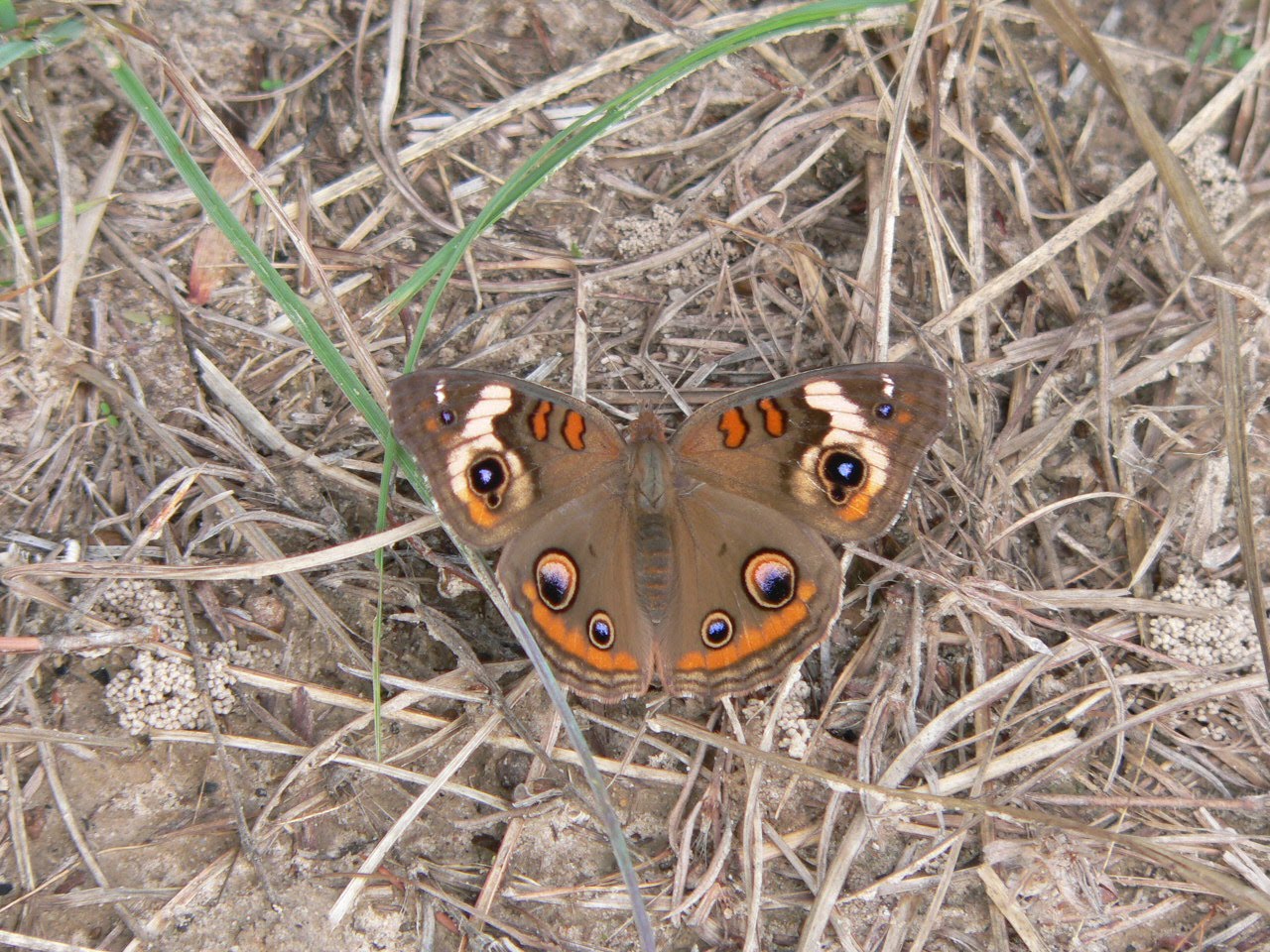
Resident Buckeyes (Junonia coenia) are active as they usually are this time of year. They overwinter here in Texas, making it kinda weird to go outside when its 40 degrees and see butterflies flitting around. The large eyespots on each wing supposedly serve to "startle" or distract anything that might want to eat it. Its beautiful frontage was featured on the U.S. 24-cent postage stamp.

We recently had a barbed-wire fence put up along one side of our property. So far I haven't seen any use of the barbs by the few shrikes I've seen in this area. Give 'em time. But what I did find was a tuft of deer fur that had apparently been left behind as it jumped the fence.

Not far from that on the lower rung of wire I found another bit of hair that was snagged from something that had crawled under it. It was not coarse and mostly gray in color. There was one strand that had a dark band at its center band. This coloration makes me think of a raccoon.

Labels: , , , , , , , , ,

Wednesday, August 05, 2009

Lubber Grasshopper

Recently a friend of mine came across this beautiful eastern lubber grasshopper (Romalea microptera) measuring about 2 ½” in length. These robust, flightless grasshoppers are considered pests known to cause damage to citrus and vegetable crops and ornamental plants. Its bright colors warn predators that it is toxic and in fact they’re so toxic there have been reports of birds dying and opossums hurling chunks after eating one these things.

Shrikes though are a little smarter and have learned how to make these beefy food items palatable. Like with most food captured they impale it on an object such as a thorn, pointed branch or even a barb on a barbed wire fence. They then allow the lubber to “age”. This aging is believed to somehow lessen the potency of its toxicity allowing the shrike to eat it. And even then this smart bird only eats the head and tail leaving the thorax region where most of the toxicity is supposedly located.

Labels: ,

Tuesday, February 13, 2007

Animal Sign


One thing I'm constantly on the lookout for when I'm in the field is animal sign. Tracks, scat, kill sites, hair, bones, nest sites, scrapes anything that alerts me of what crawls, climbs, digs, flies, runs, nests, dens, etc. in the area I'm exploring. You can learn much about animals by studying what they leave behind.
In the sandy road I find a single canine track in the sand. It measures approximately 2 3/4" long and 2" wide and fits the dimensions and appearance of a coyote track. I have found other coyote sign in this locality such as splintered deer bones and scat. The roads around here are mostly made up of coarse sand and act as excellent track traps. I have also found the tracks of foxes, bobcats, skunks, raccoons, deer, proving the presence of each of these animal in this area.
On the way to my destination I find several small patches of hair on the ground next to the barbed wire fence that runs parallel with the trail I was on. I looked at each barb on the fence and found one that had trapped several hairs matching the ones on the ground. Near the hair on the ground were deer tracks. I speculated that the barb snagged the deer’s hide as it leaped over the fence. Barb wire fences are excellent areas to look for animal sign. It can also snag the hair of other animals in the area such as bobcats, cougars, coyotes, foxes, anything that rubs up against it. It's deliberately set up by scientists studying bears in order to snag hair samples for DNA analysis which enables them to keep track of populations. Enough DNA can be sampled from hairs that will tell the gender, species, and identify the individual. When available Shrikes uses barbed wire fence barbs to impale prey, which serve as food larders. Studying these larders help you understand the diet of these birds.
Not far into the woods I came across a small mound of fresh rabbit scat. Each pellet was about 1/2" in length, and had the appearance of "squashed spheres". They were an earthy green color and consisted of plant material. The strange thing is that normally rabbits only drop one pellet at a time. An accumulation of pellets means that the rabbit for some reason stayed in one place for awhile. Had there been a predator nearby that caused it to freeze on the spot? Scat from animals can provide diet information and as with tracks prove existence in a particular area.
While resting on a log I discovered a hardwood snag that had two nice woodpecker holes about 15 foot up. They were about 1 1/2 feet apart and the lower hole was slightly taller that it was wide which points to a pileated woodpecker, which I see in this area quite often. Most times pileateds will nest in a new cavity each season in a another tree, but at times will excavate another one in the same tree, just above or below the previous one, as with this example. The top hole though has a squarish appearance and I'm thinking what happened here is that a squirrel, which at times nest in old woodpecker cavities, may have gnawed on this hole making it easier to access. There is one other large woodpecker that carves out oval entrance holes of this type, one that there's been lots of talk about lately....the ivory-bill. Though it would be nice I doubt very seriously that an ivory-bill is responsible here, especially due to the habitat it is located in. Ivory-bills prefer remote swampy old growth woods, which is getting scarcer by the day due to forest fragmentation (clearcutting, lumber harvetsing, etc). This spring I plan on setting up my ground blind nearby in hopes of observing what uses these holes. There are several good books on animal sign that I highly recommend by Mark Elbroch- "Mammal Tracks and Sign", "Bird Tracks and Sign", and his new book "Animal Skulls: A Guide To North American Species", and there's also a book by Paul Rezendes "Tracking and the Art of Seeing: How to Read Animal Tracks and Sign". When in the field don't only look for the animal itself, but also for its sign. All you have to do is open your eyes and pay attention. It makes being outdoors that much more interesting.

Labels: , , , , , ,

Web Counter
Online Schools