Friday, November 14, 2014

Camp Time With Grand-daughter


“The quiet wisdom of nature does not try to mislead you like the landscape of the city does, with billboards and ads everywhere.  It doesn’t make you feel like you have to conform to any image.  It’s just there, and it accepts everyone.”  Richard Louv
 A long awaited weekend at our camp had finally arrived and grand-daughter was thrilled to be here.  While we unpacked, she could hardly contain her excitement of getting outside to go exploring.  If I had access to a place like this when I was younger I would’ve been stoked.  Well I’m stoked now knowing that I now have this place to share with her.  Our property borders the Big Thicket which contains more diversity than any other area in the country.  In other words- it can’t get any better than this.  I’ve written before of my plan to educate her about the natural world and slowly but surely I’m beginning to see the fruits of my labor.  When we’re outside she’s the one that spots the caterpillar, or the lizard creeping in the ferns, or the hawk soaring overhead. 

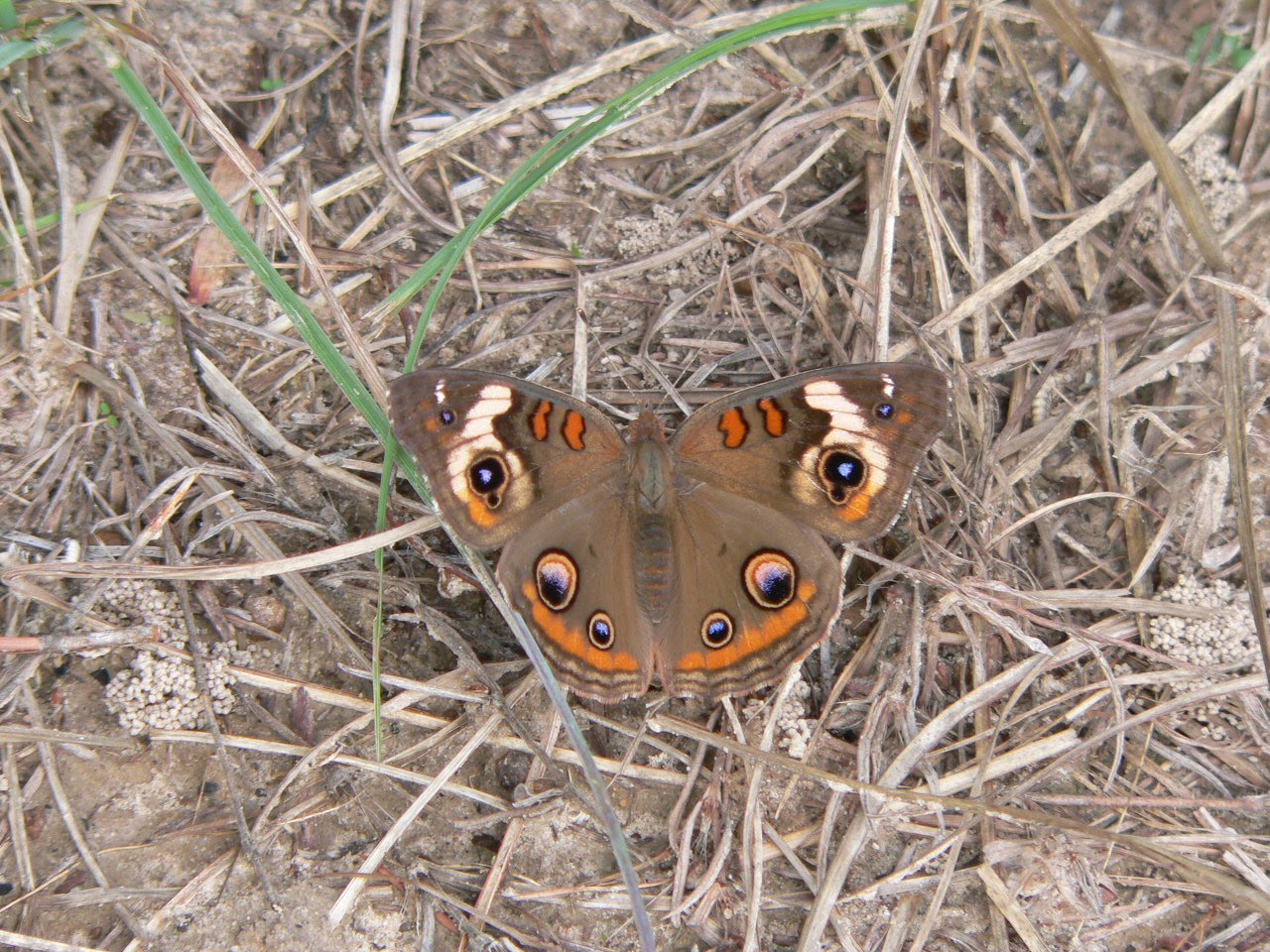
The first thing we see are buckeyes flitting everywhere along the edges of the driveway.  Yes that’s right- butterflies in the fall.  These nervous little insects have a brilliant pattern of eyespots on their wings which are believed to startle or ward off predators. They are here in this part of Texas for most of the fall during their southward migration.  I can remember seeing them on days where temps had dropped in the lower 40’s.  My grand-daughter was in awe of their beauty as they danced all around us.

I recently had bought her a book called “A Guide to Wildlife Sounds” by Lang Elliott.  It contains the sounds of mammals, birds, reptiles, amphibians, and insects.  We sat on the front porch listening to the various animal sounds on the cd and wouldn’t you know that as we were listening the call of an
eastern phoebe, one showed up and landed in the ash tree out front about ten foot from where we were seated.  What wonderful experience that was.
We also looked at some fresh mounds created by the diggings of our local pine voles.  These mounds are a part of an extensive tunnel system below ground.  We sat and watched hoping one of the beady-eyed mammals would appear, but never did.  In a sandy area we came across a nice set of fresh deer tracks.  I explained to her what had made them and then told her to “feel” the edges and interior of track with her finger.  I wanted her to get up close and personal with a mark in the sand that had been produced by a living, breathing animal.  I wanted her to feel its essence.
I then taught her how to make a plaster cast of the track.  I allowed her to mix the casting material and pour it into the track.  As Richard Louv said in his book “Last Child in the Woods” -  “Much of our learning comes from doing, from making, from feeling with our hands.” 
I could have easily mixed the plaster and poured it into the track myself allowing her to only watch.  But I didn’t.  I allowed her to do this. I wanted her to learn from doing, making, and feeling.   This “closeness” with the track will also help her to remember this experience for years to come.

I marvel at the small treasures she has collected- cicada husks, bird feathers, remnants of bird egg shells, and now a nice cast of a deer track.
Later in the afternoon right before we went inside my wife spotted a white-tail doe about 40 yards away from the house on the edge of the woods.  We sat still and watched as she watched us.   The look in grand-daughter's eyes as she watched this beautiful creature in front of us was incredible. 
I was able to get a nice photo before she trotted off.  Then, to our surprise, the next morning when we got up I looked out in the hay field and saw a white-tail buck foraging on the hay.  Grand-daughter got a kick out of that.  We were able to slowly open the front door without spooking it to get some good photos.  It was really cool that we were able to not only make a casting of a deer track, but to also get to actually see the animal that made it.  I hope and pray as she gets older she retains this love of play and the outdoors.  That she remembers and cherishes the time the two of us have spent exploring this wonderful world that God created and that she passes along her knowledge and experiences to her own children and grand-children.

Share

Labels: , , , , , , , , , ,

Sunday, July 14, 2013

Curious Fawn

The rain that passed our way a few days ago helped dampen the dust that normally clouds up when I drive this winding road to our camp house.  As I came around one of the many bends there on the road's edge was a doe and her fawn.  The doe spotted me and immediately began trotting with her flag raised along the road's edge with her fawn in tow.  It wasn't long before she cut into the safety of the woods, while her fawn continued trotting along the road ahead of me.  Why didn't it follow her?

Fawns begin to lose their white spots around the age of 3-4 months, so I assumed that this particular one was anywhere from 1-2 months of age.  Several years back I flushed one that had been bedding down in the tall grass behind the camp house while I was mowing.  At first I didn't know what I was seeing as it scurried low to the ground towards the forest. As it reached the edge of the woods it stood up and only then did I realize what it was.  Moments later I heard an adult deer snort loudly, followed by the crashing sound of them bounding off into the distance.

After a fawn is born the mother eats the afterbirth and any blood-riddled plants removing any scent or sign that a deer was just born, which could attract predators.  She then gives the fawn a thorough cleaning with her raspy tongue leaving it with basically no scent, which again helps prevent the attraction of predators specifically while the fawn beds down while its mother is away feeding. Also, fawns instinctively know that when trouble appears to drop to the ground and remain motionless.

I stopped my truck, reached for my camera and as I looked up noticed that the fawn had also stopped. Young deer this age are curious having not yet matured and was probably wondering what the large object (my truck) was stopped in the middle of the road.  Even at this young age its keen senses were at work- its ears rotating in all directions gauging the surrounding sounds as was its twitching nose testing the air for identifying scents.  I took several pictures before a car approaching from the opposite direction spooked it causing it to bound off into the woods disappearing from sight.

Another post on fawns can be found here.

Suggested Reading:

"The White-tailed Deer"  by Ilo Hiller
"The Hidden Life of Deer"  by Elizabeth Marshall Thomas
Share

Labels: , , ,

Wednesday, December 19, 2012

Book- Heart and Blood


If you truly want to "know" deer you must read this book.  I implore you to read it.   I became familiar with Richard K. Nelson's writing when I read his book "The Island Within", which immediately made me a fan.  His descriptive nature writing is insanely detailed, keeping the reader mesmerized.   Heart and Blood: Living With Deer in America is the best book I have come across yet on deer.  Not only does he delve into their natural history, but he also writes of his experiences with them, both as hunter and naturalist.  This book is impeccably detailed and researched and deserves to be added to your nature library.
Share

Labels: , , , , ,

Monday, September 24, 2012

Ruminants Eating Birds

Who would have ever thought that white-tailed deer (Odocoileus virginianus), which are herbivores, would have the occasional craving for bird flesh? I sure didn’t. I did some digging on this topic on SORA (Searchable Ornithological Research Database) and found articles from several ornithological journals speaking of this bizarre behavior.

From what I’ve discovered in the literature the first time this was noted was back in 1970 when researchers found bird remains in the rumen (first stomach) of a deer. (1) (6) In the Spring 1978 issue of Bird Banding it stated that previously in 1976, during a bird banding project, birds that had been captured in mist nets were being eaten. It was determined that deer were responsible due to their presence in the area and the fact that their tracks were found in the soil beneath the mist nest where the bird was partly consumed. (2) It wasn’t actually proven that this was happening until the years 1996-1999 when a white-tailed deer was videotaped depredating bird’s nests in grassland habitats in North Dakota. At that time it involved the nests of savannah, grasshopper, and clay-colored sparrow nestlings. Incidentally, some of the nests had been parasitized by cowbirds, which were also consumed. (3)

To take this odd behavior even further white-tailed deer have also been reported eating fish and insects.(2) (4) (5) There’s even photo evidence of deer eating meat at animal carcasses and gut piles left by hunters.(10) Another was seen eating at a dead rabbit in which it only consumed the legs and ears. (10) Here's a video of a white-tail deer I came across eating a bird:


This odd behavior has also been noted in other countries-Red deer (Cervus elaphus) on the Scottish island of Rum feed on the chicks of Manx shearwaters (Puffinus puffinus). And get this…..they’re only eating the heads, legs, and wings of the nestlings leaving feathers, flesh and skin intact. It is theorized this is due to mineral deficiencies found in the vegetation the deer consume on this island, and they eat the bony parts of the birds to supplement their diet with calcium and phosphorous that’s needed especially for antler growth. (7) (8)

Other ruminents have also been documented doing this- In southwestern Wisconsin from 2000-2001 cattle was believed to have consumed the eggs and nestlings of savannah sparrows and eastern meadowlarks. (9) On the isle of Foula in the Shetland Islands, scientists found sheep that were consuming only the legs of the unfledged nestlings of Arctic terns. (7) It is believed that the motivation for the cattle and sheep are the same as with red deer- for the minerals which are lacking in the soil and in turn the vegetation that they feed on.
Should deer, cows, and sheep now be considered as omnivores? And what effect could this have, if any, on bird populations? This is the type of odd, off the wall stuff I love reading about. There’s, I’m sure, so much more about nature that we still are totally unaware of.

References and Suggested Reading:

1) Stone and Palmateer. 1970. New York Fish & Game Journal 17(1):63 [cited by Carlson and Sloan].
      4) Olson, S.F. 1932. Fish-eating Deer. J. Mammal., 13:80-81.
      5) Shaw, H. 1963. Insectivorous white-tailed deer. J. Mammal., 44:284.
      6) IBBA News, 47:217-219, 1975.
    10) Meat-Eating Deer

Share


Labels: , , , , , , , , , , ,

Wednesday, December 15, 2010

Front Porch Ramblings

While out on the front porch of our camp enjoying a nice cigar (Acid Maduro, if anyone is interested), a red-headed woodpecker came my way landing in the ash tree that resides out front. It's probably one of the pair that hang around here. Red-heads are less likely to peck for insects as with other woodpeckers and instead, most times, prefers to flycatch for them much like bluebirds do from a perch. This is a striking bird and has acquired many other names do to its colors: patriotic bird, shirt-tail bird, jelly coat, flag bird, tri-colored woodpecker.

They're omnivorous meaning their diet varies greatly consisting of fruits, vegetables, seeds, acorns, insects, to even the eggs and young of other birds. It is also a caches food, hiding insects, sometimes live, and seeds under bark, in cracks, and even under the shingles of roofs for winter use. This woodpecker was once vilified due to its supposed damage to fruit crops and the eggs and young of other birds. Audubon didn't talk to kindly of this woodpecker as evident in a quote from Cleveland Bent's Life Histories of North American Woodpeckers:

"I would not recommend to anyone to trust their fruit to the red-heads; for they not only feed on all kinds as they ripen, but destroy an immense quantity besides. No sooner are the cherries seen to redden, than these birds attack them." He goes on to say "They have another habit, which is that of sucking the eggs of small birds."

Others are quoted as saying:

"....I consider it a veritable butcher among our nuthatches and chickadees, driving every one away from its nesting sites, and woe to the bird that this villian can reach".

"A redhead, seeing a young lark sparrow flutter in the grass, attacked it and might have killed it, had I not intervened. He struck the young bird at one of his lores and had brought blood. I have also seen this woodpecker attack a young bluebird, on the ground, just after it had left the nest".

"His victim was too much mutilated to identify positively, but looked like a half-grown bluebird, whose head had been crushed in, the brain abstracted, and the entire rump and entrails torn out."

Crawling nearby was a red wasp that appeared to have gotten in a scuffle with something more aggressive than itself. Its wings were tattered in a way that it would no longer be able to fly.

Speaking of wasps I noticed under one of the awnings a paper nest with a small wasp on it. Odd I thought, since this is late in the year for this to be happening. A closer look revealed that the wasp was in fact dead, but yet still perched upon its paper creation.

Earlier I had checked my neighbor's bluebird house and found that something had been chipping away along the edges of the entrance hole. Usually squirrels will do this to enlarge the entrance hole of a birdhouse to facilitate an easier entry, but since I have a predator guard on it I kinda doubt it was responsible. But then again we all know how ingenious squirrels can be. One other possibility is that it could be a woodpecker.

Resident Buckeyes (Junonia coenia) are active as they usually are this time of year. They overwinter here in Texas, making it kinda weird to go outside when its 40 degrees and see butterflies flitting around. The large eyespots on each wing supposedly serve to "startle" or distract anything that might want to eat it. Its beautiful frontage was featured on the U.S. 24-cent postage stamp.

We recently had a barbed-wire fence put up along one side of our property. So far I haven't seen any use of the barbs by the few shrikes I've seen in this area. Give 'em time. But what I did find was a tuft of deer fur that had apparently been left behind as it jumped the fence.

Not far from that on the lower rung of wire I found another bit of hair that was snagged from something that had crawled under it. It was not coarse and mostly gray in color. There was one strand that had a dark band at its center band. This coloration makes me think of a raccoon.

Labels: , , , , , , , , ,

Tuesday, December 01, 2009

Hello Kitty


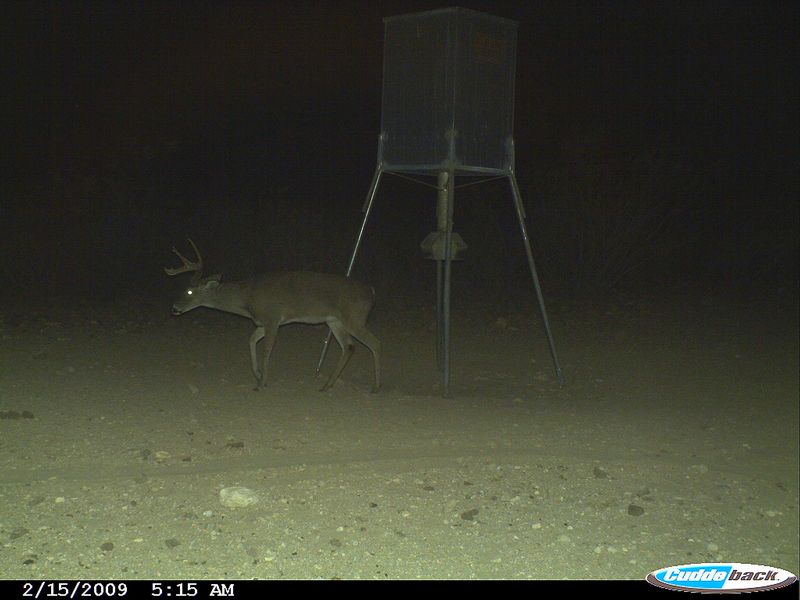
Wow.......what else is there to say. A powerful photo captured by a hunter's game camera, which is, I'm sure, not what the hunter expected. This opportunistic feline either just happened upon this deer when it was at the feeder, or through past observations began to put two and two together and made a connection between that "big box" and food. The same way a bird connects with a birdfeeder, or a bear with a trash can. Cougars are ambush hunters and usually attack from the rear going for the throat. Once this is attained its powerful jaws hang on until the deer suffocates. In the beginning this photo was consider by many as a fake, but if you look at one of the other photos taken you'll see the drag marks in the sand. Will the big cat come back for more? It would be wise not to, because the next time it could find itself in the hunter's sights......gun sights that is.

While doing a little mining on the net I came across an extraordinary video of a cougar taking a white-tail deer. Be forewarned their is a bit of "colorful" language by the videographers.


Check out these cougar guides:

Puma ID Guide

Puma Field Guide


Labels: , ,

Monday, September 14, 2009

Abnormal Antlers


Do you notice anything peculiar about this white-tailed deer? Obviously the antler on the deer’s left side is abnormal or “stunted” in comparison to one on the right. Now look closely at the right hind quarter where you’ll notice a “lump” that appears to be some sort of injury. Well believe it or not the two are interrelated. It has been found that there is a cause and effect relationship between leg injuries and abnormal/stunted antler growth. Many hunters have reported seeing this phenomenon in the field for years. And get this- from what I’ve read the only time abnormal/stunted antler growth occurs “contra-lateral” (opposite side) to the injury is when the injury is to a rear leg as with the deer in the photograph. We’re not finished- If the injury occurs on one of the front legs the antler is abnormal/stunted on the same side as the injury. There have been studies done on this weird phenomenon and to this day it’s still not understood why this happens.

Labels: , ,

Tuesday, March 24, 2009

An Afternoon In the Field

I spent the afternoon looking over a camera trap site I came across the last time I was up in the woods that’s walking distance from the house making it is easier to monitor. It consists of a narrow waterway only about two feet deep that snakes its way through this particular patch of woods. I found several game trails that ran to and from the waterway proving that something was going there to drink. A small tree that resides on the water’s edge will provide a nice spot to mount the camera. Across on the opposite bank there was an incline slope that appeared worn from use by wildlife to get at the water. Sometime in the future I plan on setting up a camera and hope to have some good results to share.


Afterward I roamed the area and came upon some woodpecker sign consisting of a large gaping maw of a hole about three foot up a rotted snag. The fissure measured approximately nine inches long, three inches wide, and close to four inches deep.
Surely, the work of the pileated woodpecker, which is prevalent in this area. Its large bill is capable of boring out holes such as this for nesting purposes or as they search for beetle grubs nestled within decomposed timber. Food acquisition is my belief since these woodpeckers normally do not bore out compartments this close to the ground. To see some nice photos from another blog of a pileated woodpecker's nest in the making go here. Not far ahead I came across the apparent bedding area of an animal. It consisted of an obvious round, flat area in soft pine straw. I assumed by the size of it that it probably belonged to a deer.
My suspicions were confirmed when I discovered a small mound of deer scat on the outer border of the area. When deer bed down the first thing they do when they rise (like most of us do) is relieve themselves.
Since this is the time of the year that deer begin dropping their antlers my eyes were constantly scanning the ground for sheds. Regretfully I didn’t come across any, but what I did find was a partial leg bone of a deer. The tiny hole at the center was where a blood vessel or nerve had entered the bone.
Note the fine etchings on the broken end. These were produced by the gnawing teeth of squirrels and/or mice who gnaw on bones and shed antlers for their mineral content. There were also coarser teeth markings more than likely made by a predator such as a coyote, bobcat, or fox.

Labels: , , , ,

Saturday, January 06, 2007

A Doe and Her Fawn


About 50 yards from my front porch I watched a doe and her fawn slowly creep from the wooded area that borders our camp and feed cautiously in the hayfield. Every so often the fawn would hop as if to play. They walked slowly and ever so often the doe would look my direction, keeping a close eye on me, lifting her flag at times causing the fawn to freeze. Normally the mother feeds alone and leaves her fawn well hidden in thick vegetation. The fawn will lay in the "camoflauge position" with its legs tucked and its body stretched out with its head and neck laid flat on the ground blending in with the leaf litter. The mother will return at intervals to nurse it. I guess as they get older they will accompany their mothers to feed. Fawns are usually weaned at about six weeks, but this one apparently wasn't as it ran up to the mother and began nursing. Click on photo to enlarge.

Labels: ,

Web Counter
Online Schools