Tuesday, January 19, 2010

Butcher Bird

"Saw a shrike pecking to pieces a small bird, apparently a snowbird. At length he took him up in his bill, almost half as big as himself, and flew slowly off with his prey dangling from his beak. I find that I had not associated such actions with my idea of birds. It was not birdlike."

Henry David Thoreau Dec. 24 1850


I came across my first shrike larder about ten years ago as I walked a long a span of barbed wire that bordered a sprawling cow pasture. To tell you the truth at the time I had no idea what I had come across. I began thinking I had discovered the morbid collection of some weird cult.


A bird of mostly open country this passerine raptor at first glimpse resembles a miniature mockingbird with the bill of a hawk. It’s our only predatory songbird, is diurnal, very aggressive and bold for its miniature stature. It does most of its hunting from elevated perches, most times along power lines making use of its phenomenal vision to spot the tiniest of prey. I’ve seen them dive from 40-50 foot perches to the ground to seize something as miniscule as a cricket. Their feet are powerful for grabbing prey, but lack the large flesh piercing talons of raptors (e.g. hawks, eagles, etc). The tip of its upper bill is hooked and has a feature near the tip known as a “tomial tooth”. It's this tooth the shrike uses to dispatch large prey (birds, small mammals, etc.) by biting through the vertebra of the neck, severing the spinal column. Prey selection is mostly insects, small mice, reptiles and amphibians, but it also will take small birds on the wing. Sometimes birds twice their size. I once spotted one in an oak tree with a magnolia warbler in its talons. What’s really interesting about these birds is their caching behavior, which involves the gruesome task of impaling prey, which by the way paved the way to its nickname “butcher bird”.


They have been reported using several types of impaling substrate such as:

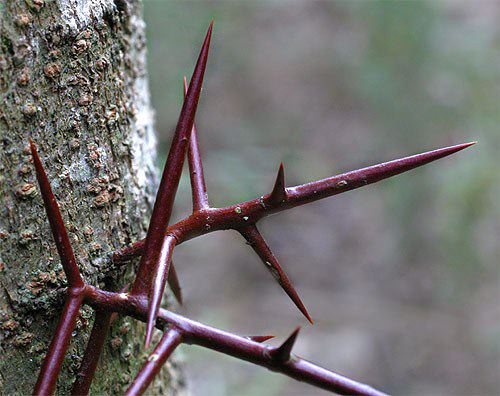
Honey locust thorns
Barbed wire
Blackbrush thorns
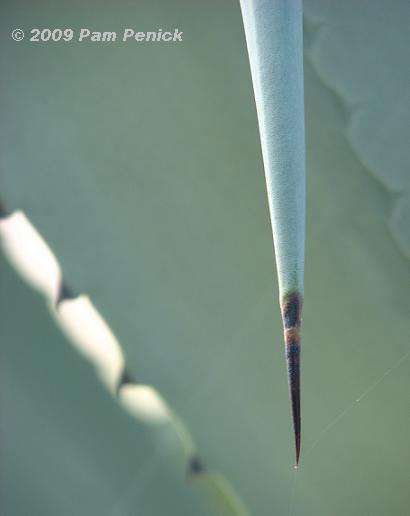
Agave plant spines
Hawthorn
Yucca
Saguaro spines
Hercules' club thorns
Sharp tree stems
Will also sometimes wedge prey in narrow branch forks


So why do they perform this ghastly act? Here's a list of possible uses of a cache or "larder":

1) Food hoarding for times of prey shortage or increased food demand (e.g. during nesting season to supplement prey brought to nestlings), during periods of stress and/or inclement weather. (1), (2), (3).

2) Impalement used to aid in food manipulation (food tearing) due to lack of talon strength. (2)

3) Large larders could impress females, which may offer some indication of the male's hunting prowess and ability to supply food. It was found there was a higher reproductive success in males with larger larders. (2), (3)

4) Used as a method of marking territory ownership and boundaries. (2), (3)

5) Chemically defended prey (e.g. monarch butterflies, lubber grasshoppers, eastern narrow-mouthed frog.) are impaled enabling toxins to degrade and allowing these to be used as food sources. (2), (3), (4), (5) .

6) Used to feed female to conserve energy during brooding. (6)


Several years back I surveyed a number of birders asking of their experiences with larder finds and observations of shrikes taking prey. Here's what I got:

Birds seen captured or impaled:

Carolina chickadee, English sparrow, Field sparrow, Northern Cardinal, Cedar waxwing, Bewick’s wren, Chimney swift, Cassin’s vireo, Ruby-crowned kinglet, Pine siskin, Chipping sparrow, American goldfinch, Painted bunting, Grey gnatcatcher, Black-capped chickadee, Yellow-rumped warbler, Ruby-throated hummingbird, Eastern phoebe, Chestnut-sided warbler, Indigo bunting, Downy woodpecker, Summer tanager, Wilson’s warbler (see photo impaled on yucca- courtesy of Brush Freeman), Tennessee warbler, House finch, Mourning dove, Red-eyed vireo, Savannah sparrow, Cerulean warbler, Broad-tailed hummingbird, Goldfinch, Bluebird, Eastern meadowlark, Mockingbird, Vermillion flycatcher, Red-bellied woodpecker, Hairy woodpeckers, American robin, Prothonotary warbler, Dark-eyed junco, European starling, White-crowned sparrow, Henslow sparrow, Inca dove, Common redpoll, Barn swallow, Virginia rail, Dunlin (northern shrike), Grasshopper sparrow, Harris’ sparrow, Zebra finch (pet store escapee), Lincoln’s sparrow, Pyrrhuloxia, Slate-colored junco, Gambel’s quail (juvenile).


Insects found impaled:

Grasshoppers, Crickets, Moths, Caterpillars, Cattle ticks (witness saw shrike removing them from a cow and then impaling them on barbed wire) (8) , Cicadas, Bees, Wasps, Beetles.


Other items found impaled:

Field mice, bats(see photo courtesy Of David Sarkozi), Northern leopard frog, crawfish, turtles, spiders, 13-lined ground squirrel (Toronto, Ontario), Lizards, Skinks, Green anoles.


Other interesting tidbits of shrike lore:

~ I had someone tell me they had seen one on the Texas coast near a wooded area where migrating passerines stopped to eat and rest following their long trip across the Gulf of Mexico. It was hypothesized that it was taking advantage of and attacking tired migrating birds.

~ They’ve also been known to impale inedible items such as fecal sacs, paper wasp nests, wool, eggshells, and snail shells. (3). They have been seen impaling twine on a barbed wire fence aiding them in breaking it into smaller pieces for nest construction. (3)

~ It is also known as French mockingbird by some.

~ A birdbander reported seeing a shrike attack a banded bird following its release. (7)

~ A group of shrikes is known as a "watch" of shrikes.

~ Chippewa Indians called this bird "big cannibal bird".

~ "Audubon (1842) quotes the Rev. John Bachman as saying: "I have seen one [shrike] occupy himself for hours in sticking up [on thorns]....a number of small fishes that the fishermen had thrown on the shore....." (8)

~ "Carrion is sometimes eaten. Prof. F.E.L. Beal while at Ames, Iowa, in January, 1880, saw a butcherbird fly over the brown frozen prairie to a carcass of a cow, where it lit on one of the ribs and greedily tore off shreds of the flesh." (8)

Labels: , , , , , , ,

Tuesday, May 31, 2011

Cool Shrike Videos

Tuesday, November 29, 2011

Gambusia Trail

A couple weeks ago I took a ride up to Sabine Pass to see what was going on in them there parts. I figured I would explore along Highway 87, stop off at Sabine Woods where a long-eared owl had been spotted, and then finish off with a trip to Sea Rim State Park.

As I was travelling down Highway 87 I spotted several red-tailed hawks flying over a field so I decided to pull over to the shoulder and watch for a while. There was a tree near the side of the road that was full of red-winged blackbirds, and ever so often they would drop to the ground below the tree to feed. One of the red-tails eventually landed in top of a tree that was about 50-60 yards away and began to watch the red-wings with intent. Even though their main prey is rodents, they’ve been known to “stoop” falconlike and attack other birds. (1) I sat there for about 30 minutes hoping that the hawk would eventually bust into the cluster of blackbirds on the ground, but it didn't so I moved on. Also in the area was a juvenile Northern harrier, (aka marsh hawk) which is a winter resident here, and was gliding low over the field. Bent gives a good description of its flight- “a lazy, loafing, desultory flight it seems, but really it is full of purpose, as it quarters low over the ground in a systemic search for its prey.” If you zoom in you’ll notice the “facial disk” on its“owl-like” head.

Impaled on the top row of wire of a barbed wire fence that borders this field was a lubber-type of grasshopper.

No doubt this was the work of a loggerhead shrike*. These insects are toxic to most birds, except for the shrike as I noted here. I went further down the fence and discovered another skewered item, this time a small frog. Not sure of its identity, because of its desiccated condition. Its posture had a gruesome appearance giving the image of an agonizing death.

Still further down was one more victim, either a large cricket or grasshopper that with a large ovipositor.

As I approached Sabine Woods I decided to venture on to Sea Rim and hit this spot on the way back. As I drove along the highway it was obvious how the drought and the brutish heat that we have suffered from this year had hit the marsh areas hard. All of these regions that normally are loaded with ducks of all types were bone dry and barren. I can't remember the last time I saw this environment in such a sad state. Once I arrived at Sea Rim State Park I noticed that the marsh areas surrounding the Gambusia Nature Trail there had suffered the same fate as the other marsh areas.

Named after the gambusia or mosquito fish, the Gambusia Nature Trail has a long boardwalk that negotiates this area allowing one to walk through the marsh to explore.

Normally this area would be flooded and teaming with life- alligators, mink, nutria, raccoons, opossum, skunks, river otters and muskrat are just some of the animals that make this area home. Not to mention the many ducks, shorebirds, marsh birds, crabs, fish, reptiles and amphibians that live here. Coyotes and bobcats* are also found in this area, so to see this is such a state is literally devastating.

I entered the park, paid my entry fee ($3.00) at the self-pay station and found a parking spot. I no sooner exited my truck when a park ranger pulled up behind me. He was just checking to make sure I had purchased an entry permit. We talked for several minutes about the dry conditions and then he let me go telling me to enjoy, that is, what there was left to enjoy. Well in my mind, even though the area was not in a “normal state”, not once did I think that there was nothing there at all to see.

On the contrary, I was thinking about how I now had access to roam in areas where normally there would be water. As I stepped upon the boardwalk I was presented right off the bat with a surprise- a pellet.

Not sure what bird coughed this jewel up, but is was a nice one. All of the items in this particular pellet (fur, bones), is what the gizzard in the bird was unable to break down. Pellets come from a number of different birds- herons, owls, hawks, terns, gulls, crows, grebes, flycatchers, shrikes, eagles, swallows to name a few. I think though it’s either from a hawk or an owl. I’m leaning more towards an owl, because it resembles the many owl pellets I have found below known owl roosts. From photos I’ve compared it to (3), it appears to possibly be a pellet from a barn owl, which are found in this area. It was 11/16" in width and 1 1/2" in length, which falls in the range of reported measurements by Elbroch, et al (3). What puzzles me though is the fact that there’s no perch. Most times pellets are associated with a bird’s nesting or roosting area and there’s no tree nearby and the walkway has no railing so did the bird land on the walkway itself and expel the pellet? Was it flying over when it expelled it and it happened to land here? I have seen gulls and kingfishers regurgitating pellets “on the wing” so I guess it’s possible for an owl. According to Elbroch, et al. (3) the stomach acid in owls is much weaker than that found in hawks. What this means is that when dissected if I find mostly whole bones, then the pellet is probably from an owl, whereas if it was from a hawk all that would be left of the bones would be fragments due to them being broken down by the stronger stomach acid. I picked it up and place it inside a Ziploc bag so that later my grand-daughter and I could dismantle it and check the condition of the bones within. I will report later on what we found.

I glassed the area ahead of me to see if anything was on the move. All that crossed my view was a small flock of sparrows and another northern harrier flying low over the marsh. The stiff winds coming off of the gulf aided at keeping the mosquitoes at bay, which was a blessing, because normally they would be viscious.

On the ground all along the edges of the boardwalk were the holes of fiddler crabs, which even though there is no water present are still active. The only live ones that I saw were just inside the quarter-sized entry hole and would immediately disappear into their tunnels upon seeing me. I jumped off of the boardwalk and began walking where once was not possible.

Scattered everywhere were the sun-bleached shells, claws, etc. of blue crabs that had once thrived here.

There were so many it gave the appearance of a bone yard. Some were still whole and intact, while other had been ravaged by predators that took advantage during this drought to feast on the stranded, exposed crabs. Seems I was not the only one that was taking advantage the dryness that surrounded me. I collected some of the more pristine ones to use as yet another educational tool for my grand-daughter.

As I walked I discovered a trail of tracks left by one of the local coyotes. I followed the trail which eventually led to one of the many areas of clustered reed that is found here. It would not surprise me at all if these canines, along with bobcats and other mammals were taking advantage of these spots for prey and to use as a hideaway for resting. Because when you think about it now that there is no water I’m sure that all makes a models of rodents that inhabit the surrounding fields are also trekking through here attracted to these reed beds, which in turn attracts predators.

I found one track that was large measuring about 3 ½ inches in length (from tip of claws to edge of rear pad) and about 2 ½ inches in width. Quite impressive.

I began to notice that the day was coming to a close and wished I had gotten here earlier so that I could explore even further. Hopefully in the coming weeks I will be able to return and take up where this post leaves off.

*(see my posts about bobcats in this area here, here, here, and here.)

*(see my other posts about the loggerhead shrike here, and here.)


References:


(1) Terres, John K. 1991. The Audubon Society Encyclopedia of North American Birds. New Jersey.: Wing Books.

(2) Wheeler, Brian K. & Clark, William S. 2003. A Photographic Guide to North American Raptors. New Jersey. Princeton University Press.

(3) Elbroch, Mark with Marks, Eleanor 2001. Bird Tracks & Sign. Pennsylvania.: Stackpole Books.

JS112011

Labels: , , , , , , ,

Wednesday, August 05, 2009

Lubber Grasshopper

Recently a friend of mine came across this beautiful eastern lubber grasshopper (Romalea microptera) measuring about 2 ½” in length. These robust, flightless grasshoppers are considered pests known to cause damage to citrus and vegetable crops and ornamental plants. Its bright colors warn predators that it is toxic and in fact they’re so toxic there have been reports of birds dying and opossums hurling chunks after eating one these things.

Shrikes though are a little smarter and have learned how to make these beefy food items palatable. Like with most food captured they impale it on an object such as a thorn, pointed branch or even a barb on a barbed wire fence. They then allow the lubber to “age”. This aging is believed to somehow lessen the potency of its toxicity allowing the shrike to eat it. And even then this smart bird only eats the head and tail leaving the thorax region where most of the toxicity is supposedly located.

Labels: ,

Friday, June 22, 2012

Unusual Cooper's Hawk Behavior


I came across an interesting post by a subscriber on the BIRDCHAT Listserv that spoke of an observation he made of a Cooper’s hawk that had captured a Ring-billed gull and then drowned it by holding it underwater. I’ve read about lots of different bird behavior, but this one came as a surprise. I've seen the outcome of shrike impalement, birds pummeling their quarry against a hard surface, hawks utilizing their tomial tooth to severe spines, but this is the first time I've come across "drowning" as a bird's methodology of dispatching prey. Incidentally, why didn’t the hawk use its tomial tooth instead? I found this rather interesting and decided to look into it further and found that this isn’t the first time this behavior had been observed and documented. Check out the videos I found of a hawk drowning a magpie and one drowning a pigeon in a swimming pool.


Suggested Reading:


1) "Death By Drowning: One Cooper’s Hawk Approach"

2) "Cooper’s Hawk “Drowning” Its Prey"

3) "Unusual Behavior of a Cooper's Hawk"


Labels: , , , , ,

Saturday, November 12, 2011

Random Notebook Scribblings 7


~ April 27, 2006-Sabine Pass, TX, HWY 87: about a quarter mile from Sabine Woods I found a live loggerhead shrike in the middle of the road. It must've been struck by a car as it flew low to the ground across the highway. It appeared to be stunned and didn't resist when I picked it up. I tried to get hold of a rehabber by phone, but was unsuccessful, so I placed it beneath some shrubbery hoping it would be ok.

~ "I spent a day by the river It was quiet and the wind stood still I spent some time with nature To remind me of all that's real."
Creed "Faceless Man"


~ July 1, 2006- Camp- Something travelled across the hayfield last night and left its mark in the sand at the camp's entrance. The tracks headed west down CR4850 towards the Pitcher Plant Trail. No claw marks seen (bobcat?). Measured 2 1/4" L X 1 11/16" W in soft sand. Tracks eventually veered off into the thicket.


~ July 2, 2006- Camp- Along a trail that runs parallel to the barbed wire fence along the west side of Mr. Adam's hayfield I found the remnants of a plucked bird. Collected feathers for possible ID. The feathers were on the ground scattered at the base of an oak tree leading me to the conclusion that it was either a hawk or an owl that had plucked and eaten the bird from the branches.


~ July 12, 2006- Camp. Not far from the camera site I found some bobcat and skunk tracks in a muddied area of the trail. Also found a few armadillo tracks on the trail. It should be noted that skunk tracks do not splay- the toes are partially fused (Elbroch p. 191).


~ April 24, 2006- Sabine Pass, TX- Sabine Woods. Deer flies are horrible today. I think DEET attracts them. Don't have a moments peace to observe anything but them. I would rather battle a horde of hungry mosquitoes than a single deer fly.....


~ "A pine needle fell. The eagle saw it. The deer heard it. The bear smelled it." American Indian saying.


Labels: , , ,

Web Counter
Online Schools