Friday, August 05, 2016

Leftover Fruit

I had some apples and watermelon so I placed it outside and had a variety of visitors that found this leftover fruit appetizing.  So don't throw that old fruit away- share it!
Gray Squirrel
European Starling
Blue Jays
Mockingbird
Red-bellied Woodpecker
Share

Labels: , , , , , , , ,

Thursday, April 14, 2016

2016 Purple Martin Season 1

The 2016 martin season has begun!  On April 6 I dropped the gourds and unfortunately found two dead martins in two separate gourds.  Each bird sustained an injury to the back of the head.  Both deaths could have very possibly been due to territorial disputes since it occurred at the beginning of the season.  Either one could have also been the result of a dispute with a European starling.  I did see a few landing on the racks not long after I put them in the air.  What ever the reason it is always sad to find this.
On a happier note,  I began performing nest checks today and have found several full and partial nests (9 full and 3 partial).  I took a photo of one of the gourds where you can see mud splattered all around the entrance.  This is from the carrying of mud to the nest for building the mud dam.

I'm planning on rebuilding my gourd rack arms for the 2017 season.  The racks I have up have been in use since 1998 and are beginning to show their age.  I will get started on them this summer/early fall.

See these prior posts:  (1)   (2)   (3)


Labels: , , , , ,

Monday, April 13, 2015

First Death of the 2015 PUMA Season

The season has barely begun and I already have a casualty.  I had lowered the gourds a couple weeks ago to pull plugs from the crescent/porch gourds when I noticed a foul odor.  Inside one of the gourds I found a dead ASY purple martin which had what appeared to be an injury on the one side of its head.
It is not uncommon for this to happen at the beginning of the season when males are involved in territorial battles for nesting sites and is definitely not the first time this has happened at my colony.  This fighting also occurs between females (see this post "Intraspecific Fighting" and "A Death in the Colony").  Then again a European starling could be the culprit.  It's really a shame that this bird survived its long arduous journey across the Gulf of Mexico to get back here, only to die in this fashion.  I checked for bands, but none were found.

Labels: , , , , , , , , ,

Wednesday, January 22, 2014

2014 Purple Martin Colony Preparations

Purple martins are starting to show up in various parts of Texas.  Seems like they just left on their long migration to South America.  I usually begin seeing them showing up at my colony around the second or third week of February, which isn't far away.
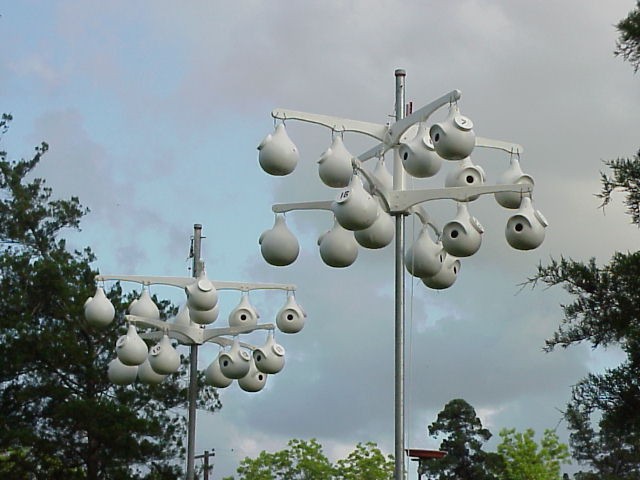
This year will mark the 20th year that I have had a martin colony and over the last few days I've began making the usual preparations for their arrival.  I cleaned out and washed the gourds in a mixture of bleach and dish washing liquid and repainted the wooden rack's arms.  Each year I also change out the ropes used to raise and lower the racks.  A rope that has been out in the elements for a year can weaken and the last thing I need in the middle of the nesting season is for a rope to break, which could be disastrous.
I also had to re-caulk several of the PVC elbows that I installed on each gourd that help with ventilation during those hot Texas summer days.  
I've began to replenish my leaf pile that I've had near the racks for years.  This allows the martins to collect nesting material near the colony so as to not waste precious energy looking for it otherwise.
Once I got the gourds attached to the racks arms I placed caps in the entrance holes until I begin to see martins in the area, otherwise English house sparrows and European starlings would try and take over.  Hopefully this will be a productive season.
Read my previous purple martin posts here.
Share


Labels: , , , , , , ,

Thursday, May 12, 2011

2011 Purple Martin Notes 4

As I walked under the first gourd rack I looked up to see a SY (second year) male looking down at me. I then looked at the ground below the gourds to see more pipped eggs. Checking on the ground below your martin housing can reveal all sorts of goings on. Today I find bad goings on.

Early in the day I had observed a male and female English sparrow entering one of the gourds where before contained a purple martin nest with two eggs, which were missing and could be included in the destroyed eggs I found on the ground. English sparrows will pip eggs as they usurp the nest of other birds. I decided to set up a gourd insert trap in that particular gourd to see if I could catch one of them, particularly the male. You see capturing and killing the female will not stop this mayhem, because the male will only find another mate. Kill the male and the female will abandon the nest and it’s over. Now I know many of you reading this (whom probably are not purple martin landlords) may object, but you must understand that this invasive, non-native species (along with the European starling) are very destructive to not only purple martins, but many other native songbirds in this country. And to allow them access to your purple martin housing will only cause your martin’s lives to become a living hell. In a nutshell- unless you control these pests you have no business putting up martin housing, because you’re doing more harm than good. Unfortunately I was unable to catch it…… today anyway.

There was some good news though….I found a total of eleven new little nestlings. In one gourd I found four young and one unhatched egg that had been pushed near the entrance. This egg was either infertile or addled. It is amazing how the adult female can tell if an egg is “no good”.

I’ve been told by folks at PMCA that they theorize that they do it by feel. This is not the first time I’ve seen this. Several years back I took an egg that had been pushed from the nest and marked it with a pencil. I then placed the egg back in the clutch with the others. Five days later when I performed the next nest check I found that the marked egg had once again been pushed out. Amazing….

NOTE: NEVER REMOVE UNHATCHED EGGS FROM A PURPLE MARTIN NEST UNTIL THE END OF BREEDING SEASON, UNLESS THEY ARE OBVIOUSLY ROTTEN, BROKEN, OR LEAKING.

Other suggested reading:

House Sparrow Revenge

House Sparrows and Starlings Are Super Competitors

Why Landlords Should Conduct Weekly Nest Checks

Don't Throw the Eggs Out!

Labels: , ,

Tuesday, April 26, 2011

Purple Martin Notes 3

It has been eight days since my last nest check, which is a little late. I normally do this every five days, the rule of thumb being every 5-7 days.


Before I got started I found an egg on the ground that had a gaping hole in it. Tiny black "sugar" ants had discovered it and were feeding on the contents. It's a good possibility it was an English sparrow or European starling that possibly "pipped" this egg. But then again, it could also have been another purple martin that's responsible. Sometimes the urge to mate becomes so intense in unmated SY (second year) males they will destroy a nest of eggs and even kill young in order to get the parents of those eggs/young into thinking reproductive failure has occured and consequently dissolving the "relationship". This in turn frees up the female for the unmated SY male to then possibly have a partner. This behavior is termed "infanticide". I wrote an article about my experience with this for the PMCA several years back. This behavior is seen in other species of birds also.


The check yielded a total of 45 eggs not counting the single egg I found in a vacant gourd. This is odd to find an egg where there isn't even a nest for it. Why did this happen? Was the egg infertile and moved to this empty gourd by one of the parents? Normally they would either push an infertile or addled egg out of the nest bowl or completely out of the nest to the ground. This is what I like about being a landlord- lots of interesting behaviors and questions to be pondered.


Labels: , , ,

Monday, May 11, 2009

First Nest Check of the Season

I lowered the gourd racks at my purple martin colony to see if egg laying has begun. They tend to bury their eggs deep in the confines of the leaves that make up most of their nest to hide them from predators. I gently poked my fingers into the nest “bowl” of each nest and counted by feel. I come up with a total of 58 eggs from 17 nests, but I expect the number to come close to doubling in the next week. There were several full blown nests in four other gourds that had no eggs in them, but very well could have some on my next check.

Many people that I have introduced to purple martins are awe struck at how the adults seem so at ease while I examine their nests. In one photo you’ll note how a few of the adults landed in the top of a nearby sweet gum tree waiting for me to finish. Most believe the old wives’ tale that if you touch a bird’s eggs, nest or nestlings the adults will abandon the nest. This is totally untrue. The parents have invested a lot of time and energy in this task and won’t just turn and waste it. Now there have been times when I’ve been strafed by adults while examining their nests, coming so close that I could feel the rush of air created by their wings as they grazed my face. I just ignore their advances and continue with my work. Actually purple martins are very tolerant of humans around their colony and in fact prefer nesting near us because it lessens the chance of a predation. More importantly they are completely dependent upon humans for nesting sites, especially since the introduction of two non-native species of birds in the 1800's, the English house sparrow and the European starling, which compete savagely for nesting sites. If not for myself and thousands of other landlords taking responsibility and managing their colonies the purple martin population would without doubt become decimated.


Labels: , ,

Thursday, June 05, 2008

2008 Purple Martin Colony Update Part 2

The season is going along quite well except for a few lost nestlings. So far my records indicate that I have 8 nestlings that are missing. This could be the result of several different factors.

Infanticide- It is believed that unmated SY (second year) male martins perform this act because of limited nesting sites, mates, and food which then is intensified by the urge to mate. By removing and/or killing purple martin young or destroying eggs it causes the mated martin pair to "divorce" so to speak due to supposed reproductive failure. This gives the SY male a chance to take advantage of the situation and possibly mate with the now "free" female.

Fallouts- caused by overcrowding leading to a nestling being pushed from the housing by one of its siblings during the rush to the entrance to be fed. The SuperGourds I use are really roomy so I don't think this was the cause, but then again it could still happen.

Ectoparasites- massive infestations of nest mites could cause nestlings to jump from the housing. Don't think this was the cause either due to the fact that I watch for this when I perform nest checks. If I find a large amount of mites I remove the nestlings, wash out and dry the gourd and then add fresh nest material in the form of pine straw and leaves.

Predators- crows, hawks, owls, snakes, etc. To my knowledge I've never had a problem with predators, but that doesn't mean it didn't happen.

Nest site competitors- such as the larger European starling or English sparrow could be responsible for their removal.

Since I didn't find any bodies on the ground below the colony it's difficult to say exactly what happened. This is just one of those things martin landlords go through each season.

Note in the photo below the “formation” that the 2-day old nestlings are in. When temperatures are cool outside nestlings will huddle up together to share each others body heat, but when it is hot out they will get into this type of spread out formation in order to stay cool. The two eggs that are remaining are past the hatching date and assumed infertile.


These three older nestlings below are due to fledge any day now. I’m betting that when I check again in 5 days they’ll be gone. Fledged nestlings usually remain with the parents for several weeks after fledging. I’ve seen fledglings being fed by adults while on the wing and when perched in treetops. In the evenings the fledglings return to the gourd they were born in to roost for the night and will continue to do this until they’re independent which usually happens before they migrate with the adults back to South America.
As you can see here this gourd is being used by a persistent pair of English sparrows. The more I tear out the more they build- as if by some act of defiance they continue their quest to procreate, to advance their species no matter how long it takes. That my friends is the way of the English sparrow. As much as I despise them I must give credit for their unbridled determination. I've been too busy to insert a trapping device. When one is installed you must under no circumstances leave it unattended. A martin or other bird could enter, become trapped and possibly die.


Labels: , , , , , ,

Saturday, March 29, 2008

Nest Site Competition

The season begins as always with the competition for nest sites. Both European starlings and English sparrows (both non-native species) try and take over martin nest sites for themselves before and after the purple martins arrive. Not much so with starlings at my colony as I’ve noticed over the last five years. Whether it’s because of the use of gourds as housing or because of martin numbers, I just don’t have as much problem with them anymore. Thank goodness. But with the English sparrow it’s a different story.
Their nests were found in four of my gourds that have a crescent entrance, which primary purpose is to prevent the European starling from having access to them, but not the sparrow. Since I began using the crescent-holed gourds the English sparrows have gravitated to them mainly due to the presence of a porch which is needed by the martins in order to give them leverage to enter. As a matter of fact there’s no way to keep these sparrows out of your martin housing because they’re smaller than martins and a reduced entrance does no good.
Knowlegable and experienced landlords are aware of the devastation the English sparrow can have on a martin colony and will go to any lengths, including trapping and shooting to prevent them from taking over. If this isn’t done you and your martins will regret it. They will pip martin eggs allowing bacteria to enter killing the embryos and have been known to peck martin nestlings to death.

There is a trapping device that can be obtained from the PMCA which attaches itself inside the gourd. A small wire inside on the device acts as a perch and triggering mechanism that shuts the metal door trapping the sparrow inside which can then be disposed of.
Unmanaged housing does more harm than good to the purple martin, so if you can’t be responsible and keep your housing clean of this pest then you have no business putting up martin housing in the first place.

To read more on this aggressive pest check out these sites:

http://www.whazsup.com/sscontrol.shtml
http://www.abirdshome.com/pm/pests.htm http://purplemartin.org/forumarchives/archive/Supercompet.htm http://purplemartin.org/forumarchives/archive/HSrevenge.htm http://www.wtc.ab.ca/northernskys/sparrow.htm

If you think the English sparrow is bad, the European starling is ten times worse. More on this bird in a future post.

Labels: , , , ,

Friday, March 16, 2007

Purple Martin Colony Update


Purple Martins are beginning to show up in force, and so far I've counted about 7 pair that have arrived. I've averaged around 23 pair over the last several years so there are more to come. English sparrows are (as usual) trying to take over atleast 3 of my 32 gourds and I continue to remove their trash filled nests to deter them. This along with an increased number of martins as the season progresses will in time cause them to just give up. Good riddance. These nest site competitors are vicious in that they will kill martin nestlings and destroy martin eggs if not kept under strict control. European starlings, another aggressive non-native nest site competitor has become less and less of a problem ever since I went to mainly gourd housing. There are some nice martin houses out there, but I strongly suggest anyone considering starting a martin colony or wanting to change or replace housing to use gourds. The SuperGourd, sold by the Purple Martin Conservation, is made of thick, tough, high-density polyethylene plastic that will, in my opinion, last forever. As the season progresses I will keep everyone informed on the goings on at my colony.

Labels: , , ,

Friday, January 12, 2007

Return of the Purple Martin


The return of North America's largest swallow, the purple martin has begun. Sightings have been reported in Florida and Louisiana. Over the last 12 years that I've had a colony, their average return date here is around the second or third week of February. My 32 Supergourds are up and ready, but I'll keep them plugged until I begin seeing them in the area, otherwise their two main nest site competitors, the European starling and the English sparrow, would try to move in. If you have any experience with a martin colony you know how much a pain in the *** these two birds can be so it's best to keep them in check by any means. As the season progresses I hope to post any and all things interesting that I come across. Hopefully this season will be one of many new fledglings.

Labels: , , ,

Wednesday, February 22, 2006

Purple Martins Are Back!!


This evening close to dusk I heard a familiar chortle coming from above. I looked up and immediatley spotted about a dozen purple martins. These are the first I've seen this season, which puts them pretty much on time. I have been reporting my "first" or scout sightings each season to the PMCA (Purple Martin Conservation Society) since 1998. I took a look at those 8 years and found out that on average they begin arriving at my colony around the 20th of February. Pretty close I'd say. At the beginning of the season I keep the holes of my gourds plugged until martins are in the area to keep the English house sparrows and European starlings from entering them, so I immediately dropped each rack and removed the plugs. While I was doing this the ones I spotted began flying overhead. You know what's amazing???? If they've had succsessful proir nesting seasons and have survived the long flight back from South America the same martins return to the same colony site year after year. This has been proven through banding studies. So my 12th season as a purple martin landlord has begun. As it progresses I will post colony observations, photographs, and any other interesting information that presents itself. Wish me luck on hopefully another successful season!

Labels: , ,

Web Counter
Online Schools