2016 Purple Martin Season 3


Labels: gourds, pmca, puma, purple martin, purple martin colony, subadult male
posted by Jace Stansbury at 11:04 AM
1 comments


Labels: gourds, pmca, puma, purple martin, purple martin colony, subadult male
posted by Jace Stansbury at 11:04 AM
1 comments

Labels: pmca, puma, purple martin, purple martin colony, subadult male
posted by Jace Stansbury at 3:36 PM
0 comments


Labels: european starling, pmca, puma, purple martin, purple martin colony, swallow
posted by Jace Stansbury at 12:54 PM
0 comments


Labels: birds, colony, martins, nature, nature blog, nest check, pmca, puma, purple martin, purple martin colony, swallow
posted by Jace Stansbury at 7:55 PM
0 comments


Labels: bird, european starling, intraspecific fighting, martins, martinwatch, nest-site competitors, pmca, puma, purple martin, swallow
posted by Jace Stansbury at 6:51 PM
0 comments


Labels: pmca, puma, purple martin
posted by Jace Stansbury at 7:05 AM
0 comments


Labels: english sparrow, european starling, gourds, martins, pmca, purple martin, supergourd, swallow
posted by Jace Stansbury at 7:51 PM
0 comments


Labels: infertile eggs, pipped eggs, purple martin
posted by Jace Stansbury at 8:19 PM
0 comments


Labels: capped egg, purple martin
posted by Jace Stansbury at 6:42 PM
2 comments
 Purple martin season is upon us and like last year I waited until the last minute to get my gourds cleaned, repaired, and ready for the new season. Getting ready involves quite a bit of work so waiting like I did put me in a bit of a rush, and I don't like to rush. I have promised myself that at the close of this season I would make sure that everything is done in a timely matter for the 2013 season.
 While inspecting the racks that hold my gourds I found a rotten spot on one of the arms that needed fixing. What I need to do is remove that damaged arm and replace it, but I decided to strengthened it with some metal strapping until I can replace it at the end of this season. The repair job actually turned out pretty good.

 I checked the PMCA website and saw that they’re arriving along the Florida, Louisiana, and Texas coasts. As a matter of fact some were sighted today in Orange, TX, which is not very far from where I live. Each year the PMCA asks purple martin landlords to submit their sightings of purple martin “scouts” during their migration back to the United States and Canada.
 Even though they're showing up right down the road in Orange, I'm pretty sure they won't be over at my colony for another three weeks. If you look below at the list of their arrival dates here over the last 14 years, you'll see that on average they start showing up around the third week of February.
Labels: gourds, pmca, purple martin
posted by Jace Stansbury at 5:48 PM
1 comments
 As I walked under the first gourd rack I looked up to see a SY (second year) male looking down at me. I then looked at the ground below the gourds to see more pipped eggs. Checking on the ground below your martin housing can reveal all sorts of goings on. Today I find bad goings on.
 Early in the day I had observed a male and female English sparrow entering one of the gourds where before contained a purple martin nest with two eggs, which were missing and could be included in the destroyed eggs I found on the ground. English sparrows will pip eggs as they usurp the nest of other birds. I decided to set up a gourd insert trap in that particular gourd to see if I could catch one of them, particularly the male. You see capturing and killing the female will not stop this mayhem, because the male will only find another mate. Kill the male and the female will abandon the nest and it’s over. Now I know many of you reading this (whom probably are not purple martin landlords) may object, but you must understand that this invasive, non-native species (along with the European starling) are very destructive to not only purple martins, but many other native songbirds in this country. And to allow them access to your purple martin housing will only cause your martin’s lives to become a living hell. In a nutshell- unless you control these pests you have no business putting up martin housing, because you’re doing more harm than good. Unfortunately I was unable to catch it…… today anyway.
 There was some good news though….I found a total of eleven new little nestlings. In one gourd I found four young and one unhatched egg that had been pushed near the entrance. This egg was either infertile or addled. It is amazing how the adult female can tell if an egg is “no good”.
 I’ve been told by folks at PMCA that they theorize that they do it by feel. This is not the first time I’ve seen this. Several years back I took an egg that had been pushed from the nest and marked it with a pencil. I then placed the egg back in the clutch with the others. Five days later when I performed the next nest check I found that the marked egg had once again been pushed out. Amazing….
Labels: english sparrow, european starling, purple martin
posted by Jace Stansbury at 6:23 AM
0 comments


Labels: english sparrow, european starling, infanticide, purple martin
posted by Jace Stansbury at 8:00 PM
0 comments
 Yesterday I found the first purple martin eggs of the season nestled in a nest’s bowl. So far I've got nests in 22 of my 32 Supergourds and hopefully each will be filled with eggs in the days to come. I'll know more in about four more days when I check them again. One of the local cooper’s hawks has been busy. I watched the other day as a male grackle mobbed it while it flew away with a nestling in its clutches. Hope they steers clear of my colony…
Labels: cooper's hawk, grackle, purple martin
posted by Jace Stansbury at 7:31 PM
0 comments
 Here we go again.... My purple martins have begun nest building and while doing nest checks I came across this dead ASY (adult second year) female. Intra-specific fighting among females pretty much occurs at the beginning of every season when females battle it out for their chosen nest site.
  I've written two blog posts about this before here. So far fourteen gourds out of thirty-two have nests in them. Hopefully this season will be a profitable one, but then there's hurricane season looming in the background.
Labels: intraspecific fighting, purple martin
posted by Jace Stansbury at 4:00 AM
0 comments
 I always tap on the pole that supports my gourd racks before I lower them just to let any incubating adults inside know that I’m present. No sense in surprising them. They’ll exit the gourds and along with the adults that were perched on the racks will fly to a nearby sweet gum tree or to a perch that I provide where they watch and wait for me to finish my landlord duties.
 Today one lone female decided that she wasn’t going to leave her eggs. She eventually left the gourd, which enabled me to count her five glistening eggs.
 By the way, the reason the egg’s shell begins to “shine” is due to the rotation of the eggs by the adults as they’re incubated so that they are warmed evenly. The eggs rub against the nesting material (leaves, pine straw, and small twigs) as they’re turned polishing them.
Labels: cooper's hawk, purple martin
posted by Jace Stansbury at 6:51 PM
0 comments
 While mowing grass I watched as one of my purple martin (Progne subis) gourds fell to the ground like an apple falling from a tree. The martins have showed back up at my site and good thing the nesting phase had not begun. If it had I would have a bunch of scrambled eggs in that gourd. I looked up at the rack and noticed that the wire that it was hanging from had broken.
 It had worn out from the gourd swinging in the wind. I then decided to change out all of the wires so this same thing doesn't happen when they begin laying.
 Out of the corner of my eye I spotted something black hopping across my front yard. It was a spicebush butterfly (Papilio troilus) that appeared to have just crawled from the confines of its chrysalis with its wings still not quite dry. I helped it out by placing it under a nearby bush so a hungry bird wouldn't spot it out in the open.
 My son was lifting up a block of cement that rests in our yard and I noticed a squirming bundle beneath it. Come to find out we discovered the love nest of a couple of rough earth snakes (Virginia striatula). I'm always finding these when I work out in the yard having to relocate them to keep them away from the strings of my weedeater. They're harmless and love earthworms and spiders. Great to have in your flower garden.
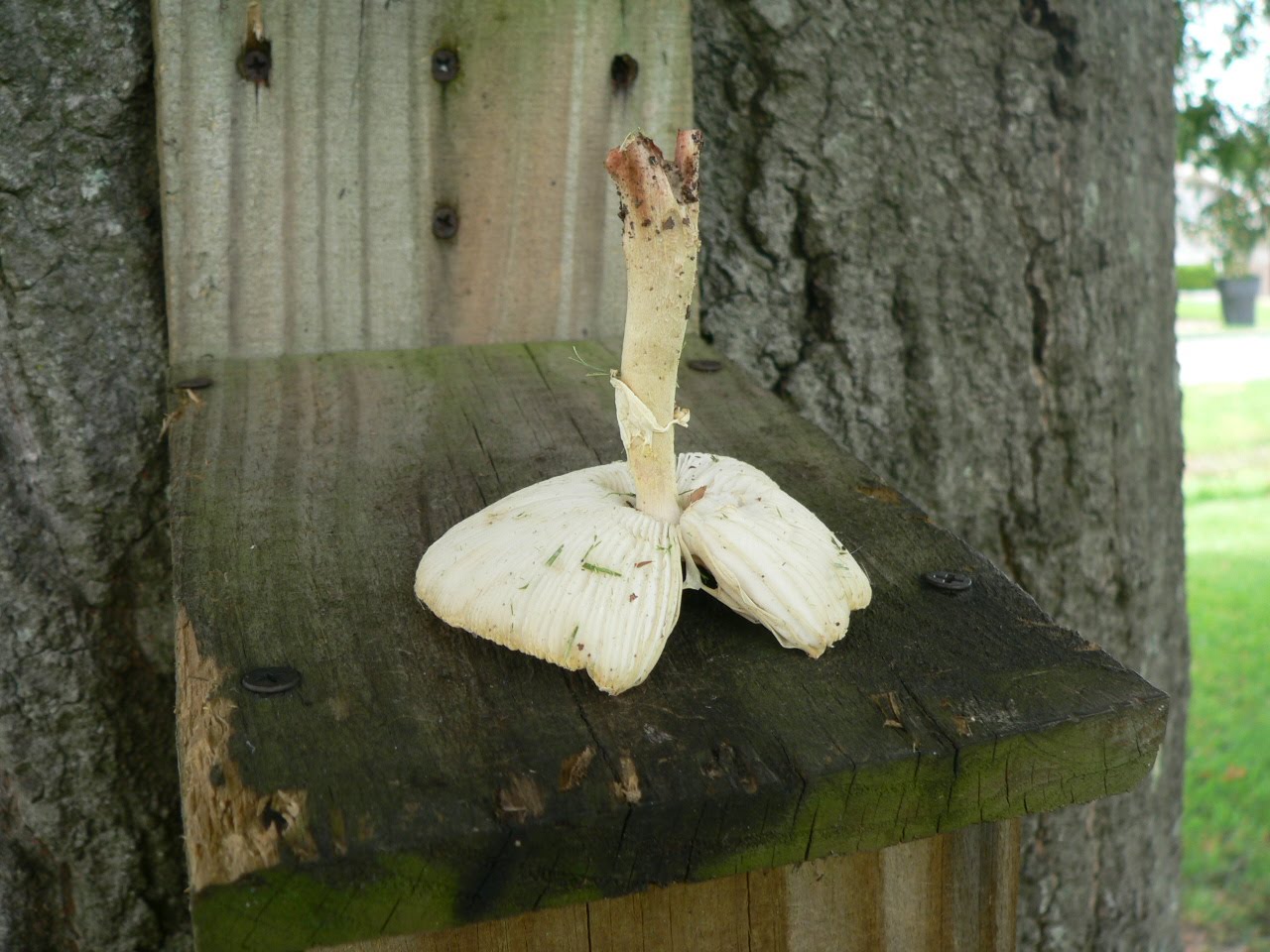 Squirrels like eating mushrooms they come across when foraging. I found this one sitting on top of a bird feeder I have attached to an oak tree that local gray squirrels (Sciurus carolinensis) use frequently. They will cache mushrooms, sometimes hanging them in the crook of a branch in order to dry them out. Squirrels are known to even eat mushrooms that are poisonous to humans, such as the amanita (Amanita muscaria). Some believe that due to their short digestive tract the poisons are not in their systems long enough to do harm.
Labels: gray squirrel, mushrooms, purple martin, rough earth snake, spicebush butterfly
posted by Jace Stansbury at 7:00 AM
0 comments
Labels: purple martin, Texbirds
posted by Jace Stansbury at 1:30 PM
0 comments


 June 27, 2004
Labels: alligator, Arches National Park, bigfoot, Delicate Arch, dragonfly, feral hogs, purple martin, swamp darner, yellow-bellied racer
posted by Jace Stansbury at 7:30 AM
0 comments

| CURRENT MOON moon phase info |
 Follow @jaceman2


range.gif)
