Sunday, September 14, 2014

Chrysalis vs. Chalcid Wasp

Back on August 17th my granddaughter and I were out in the front yard trying to get a photograph of a hummingbird that was feeding on some turk's caps.  All of a sudden I hear her cry out "paw paw look!"  I turn to see the chrysalis of a spicebush butterfly attached to a metal birdhouse we have hanging in one of our flower gardens under a camphor tree which, by the way, is one of this butterfly's  host plants.  I had been standing right next to it and  never noticed.  I'm constantly amazed how she has become adapted at observing things, most times before I do.
We decided to keep an eye on it day to day to see if we might be lucky enough to be around when the butterfly emerged.  That was to never be.  What I should have done was placed it in a jar protecting it from its natural enemies.
Today we found that it had a tiny hole in it.  And when I saw this I knew it meant trouble.  This is the workings of a chalcid wasp.  These tiny wasps lay eggs into the chrysalis during the time that it is formed when the tissue is soft.  The eggs hatch and the resulting larva consume the insides of the chrysalis and eventually develop into wasps which then bore a hole, as seen above, to escape.

Note in the first photo how the back end of the chrysalis is relatively straight.  In the second photo it is bent.   This is one of the signs of chalcid infestation.  Once the eggs of the wasp develops inside and begins to consume the developing butterfly within, the chrysalis dies and the muscles that once held it straight relax causing the bend to form. 

Check out this cool video showing how this wasp develops:


References and Suggested Reading:

1) Spicebush Butterfly Post
2) Chalcid Wasp Links  (a), (b)
3) Caterpillars of Eastern North America

Labels: , , , , , , , , , , , ,

Wednesday, April 14, 2010

Notebook Jottings 5

"Study nature, not books." ~ Louis Agassiz

While mowing grass I watched as one of my purple martin (Progne subis) gourds fell to the ground like an apple falling from a tree. The martins have showed back up at my site and good thing the nesting phase had not begun. If it had I would have a bunch of scrambled eggs in that gourd. I looked up at the rack and noticed that the wire that it was hanging from had broken.

It had worn out from the gourd swinging in the wind. I then decided to change out all of the wires so this same thing doesn't happen when they begin laying.

Out of the corner of my eye I spotted something black hopping across my front yard. It was a spicebush butterfly (Papilio troilus) that appeared to have just crawled from the confines of its chrysalis with its wings still not quite dry. I helped it out by placing it under a nearby bush so a hungry bird wouldn't spot it out in the open.

My son was lifting up a block of cement that rests in our yard and I noticed a squirming bundle beneath it. Come to find out we discovered the love nest of a couple of rough earth snakes (Virginia striatula). I'm always finding these when I work out in the yard having to relocate them to keep them away from the strings of my weedeater. They're harmless and love earthworms and spiders. Great to have in your flower garden.


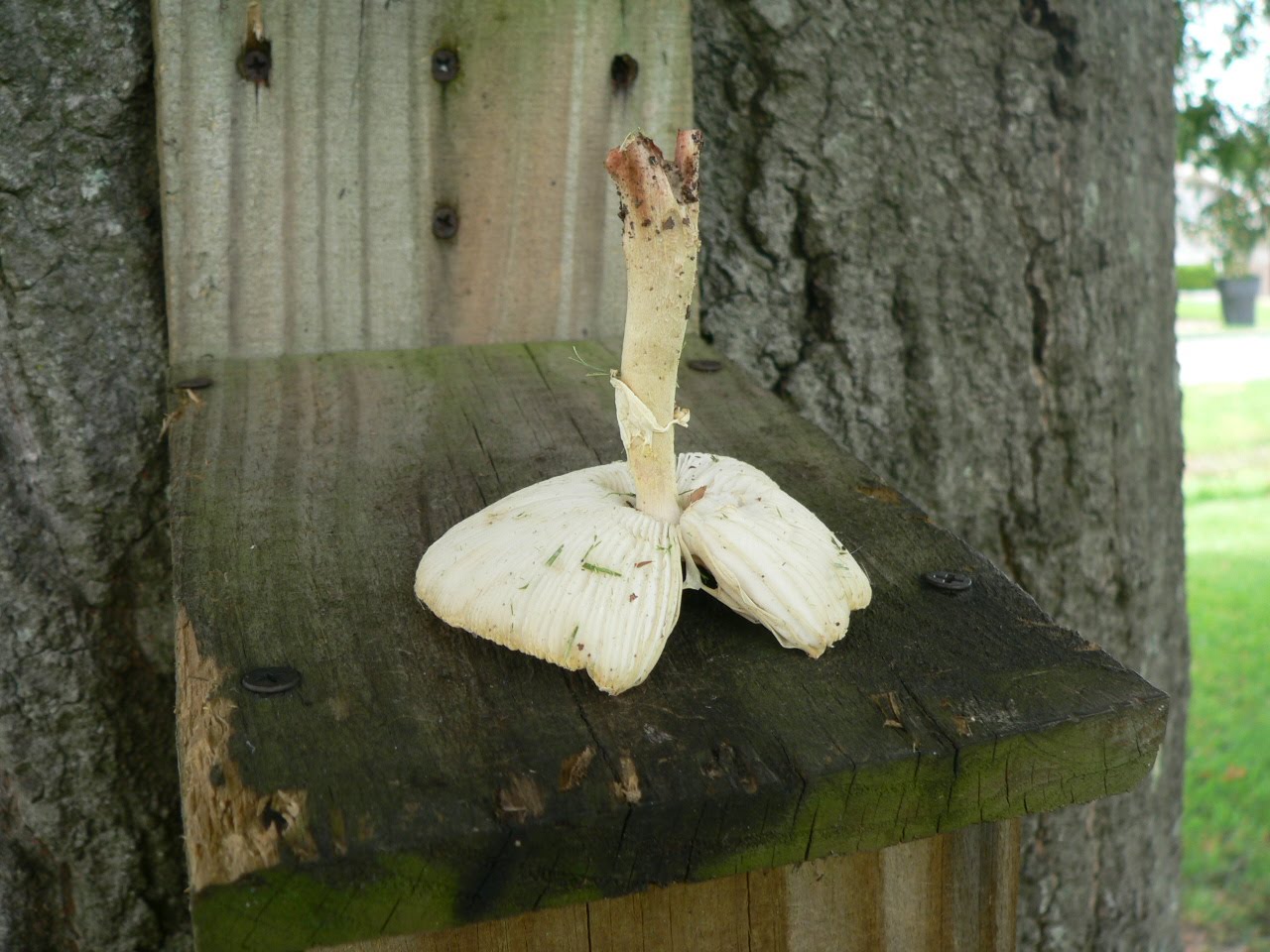
Squirrels like eating mushrooms they come across when foraging. I found this one sitting on top of a bird feeder I have attached to an oak tree that local gray squirrels (Sciurus carolinensis) use frequently. They will cache mushrooms, sometimes hanging them in the crook of a branch in order to dry them out. Squirrels are known to even eat mushrooms that are poisonous to humans, such as the amanita (Amanita muscaria). Some believe that due to their short digestive tract the poisons are not in their systems long enough to do harm.

Labels: , , , ,

Web Counter
Online Schools