Friday, August 05, 2016

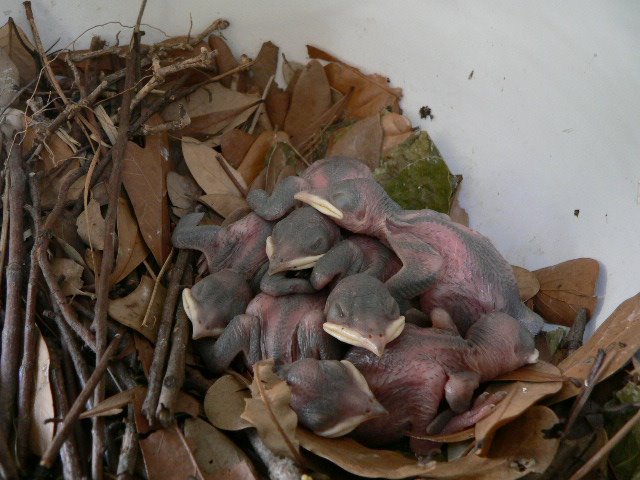
Finding Baby Birds- What To Do

If you've ever wondered what to do if you come across a nestling on the ground, check out this website that has good information:

http://www.fws.gov/midwest/news/foundbabybird.html

Share

Labels: , , ,

Friday, May 16, 2008

2008 Purple Martin Colony Update

On April 19th I lowered my gourd racks to find my first clutch of 5 eggs for the season, and then on May 1st I had 18 nests containing a total of 88 eggs. Also on this day I found an 8-egg clutch in one of my gourds which is very rare. Over the years I have had several 7-egg clutches, but the only other time I had 8 was in 1996 in a wooden house I built which turned out to be a renest attempt. Purple martins sometimes will attempt another clutch of eggs if the first fails to hatch or is lost due to predators.
Normally with clutches of 7 or 8 not all of them are destined to hatch. I had an exception back in 2002 when a clutch of 7 all hatched, but only 5 of those fledged. At my particular site in the beginning (1995-which consisted of houses only) the average clutch size ranged from 4-5 eggs with an occasional clutch of 6. Ever since I went to an all gourd colony in 2001 I’ve noted an increase in 6-egg clutches, which is one of the main reasons why I converted. Gourds, due to their roominess and other attributes, have shown to increase clutch size and produce greater reproductive success. Hopefully I will luck out this time and have all 8 hatch and fledge. I’ll keep everyone up to date on this particular clutch as the season progresses. As of May 13th I have 96 eggs and 12 nestlings, which tallies up to a total of 108 eggs laid thus far.
The nestlings in this photo are approximately 7 days old, determined by using a set of laminated life-size photos of a developing nestling that can be purchased from the PMCA. You take the nestling from the nest and lay it on top of the photo that most closely matches its size and voila you have its age. Note the large uneaten green darner dragonfly amongst the nestlings. Surprisingly it still has it head- usually the adults will remove it so the dragonfly doesn’t bite on the way down. Also this is a rather large dragonfly for these young nestlings. I found a dead one back in 2002 after it had choked on one this large.
In another nest I found what is known as a “capped” egg. If one or more eggshell hemispheres remain in the nest after a nestling hatches chances are a half could end up attached to the end of any remaining unhatched eggs as seen in the photo. If this happens the nestling inside the egg may have difficulty hatching. I gently picked up the egg, removed the cap and placed it back in the nest. Most times the adults will eat the remaining egg shell (for its calcium content) and other times fly away from the colony to drop them off just like they do with the nestling’s fecal sacs, because dropping either of these on the ground below the colony could possibly attract predators.
Just one more reason why it is so important for martin landlords to perform regular nest checks on their colony. Another update will appear at a later date.

Labels: , , , , , ,

Sunday, May 04, 2008

Bluebirds- Season Two- Part Two

Went up to camp and spent some time with my bluebirds and found 5 fuzzy nestlings all huddled up in the center of the hay nest. The slightest of noises or movement of the box triggered them to gape their maws expecting to be fed as seen in the short video as I whistled.


I set up a blind near the box so I would be able to get some closer photos of the adults as they returned repeatedly with their beaks full of insects. Feeding behavior changed after I set up the blind- before they would land on top of the box, sit for a bit, then perch at the entrance, pause, and then enter. Now they’re flying straight into the hole. What accuracy! Once they became accustomed to the camo monstrosity where I sat hidden they reverted back to the slower method of feeding.
The open hayfield I have nearby supplies plenty of bugs to keep them all well fed. Normally they’ll fly to one of the nearby oaks, watch the ground for movement, and then dive upon any insect that gives its self away. Other times I’ve seen them hovering low over the ground before dropping to get their quarry.
In the next video watch closely as the adult springs from the box. Notice the white object in its beak- that is a fecal sac. This is the feces of the nestlings which the adults remove as needed. Instead of dropping them on the ground below the box, which would attract predators, they will fly a distance away from the nest site and drop them. Purple martins also do this.

Labels: , , ,

Saturday, May 19, 2007

First Purple Martin Nestlings of Season

Dropped the gourds today to find the first nestlings of the season. Tiny and pink and oh so helpless, but you'd be amazed at how fast they develop. And there are still 101 eggs that haven't hatched yet! Statistics say they will not all hatch, but it doesn't hurt to hope. As more eggs begin to hatch activity at the colony will increase as the parents will be working their tails off collecting food for the ever gaping mouths of their young.

Labels: , ,

Monday, April 16, 2007

Bluebirds Hatching


I checked my bluebird housing this weekend and found that two of the eggs had hatched. Well actually when I first checked it the adult female was sitting on the nest to keep them warm. We had a cool front come through which dropped the temps down into the forties. During days like these- breezy and cool- the female will spend her day warming the chicks while the dutiful male will hunt and feed her and what she doesn't eat she feeds to the nestlings.
I watched him land atop a 10 foot pine snag out front and from there he would inspect the ground below for insects.
Their eyesight is amazing....he would leave his perch and drop into the hay 50 yards away and then return with his catch where he would then pummel it against the top of the snag, killing the insect.
From there he would deliver it to the house. Later in the day the female decided to stretch her wings which allowed me to have a look at the nest. Inserting the mirror I see two nestlings and three unhatched eggs. I hope to return in a few days to find the entire clutch hatched. I also checked my neighbor's box and found he had 5 eggs.

Labels: , ,

Friday, May 12, 2006

Hatching Has Begun


I performed a nest check today and hatching has begun. I have a total of 58 eggs and 37 young.
Now that eggs have begun to hatch activity at the colony will increase twofold. The parents will make many sorties back and forth to their respective gourd bringing food (dragonflies, moths, butterflies, and other flying insects) to sustain the ravenous appetite of their growing young.


With each nest check the nestlings will appear to have doubled in size. Check out the photos. The first photo shows 3-day old young and the next shows 8-day old young. It's incredible how fast they develop. Within 25-28 days after they hatch they will be fuly feathered and ready for their maiden flight. To watch an animation showing the development of the purple martin nestling from egg to fledgling go here.

Labels: ,

Web Counter
Online Schools