Monday, June 24, 2013

Spider Surprise

“The bodily structure of a spider is so efficient, so near perfection for its purpose, that one must admire it.” Hal Borland

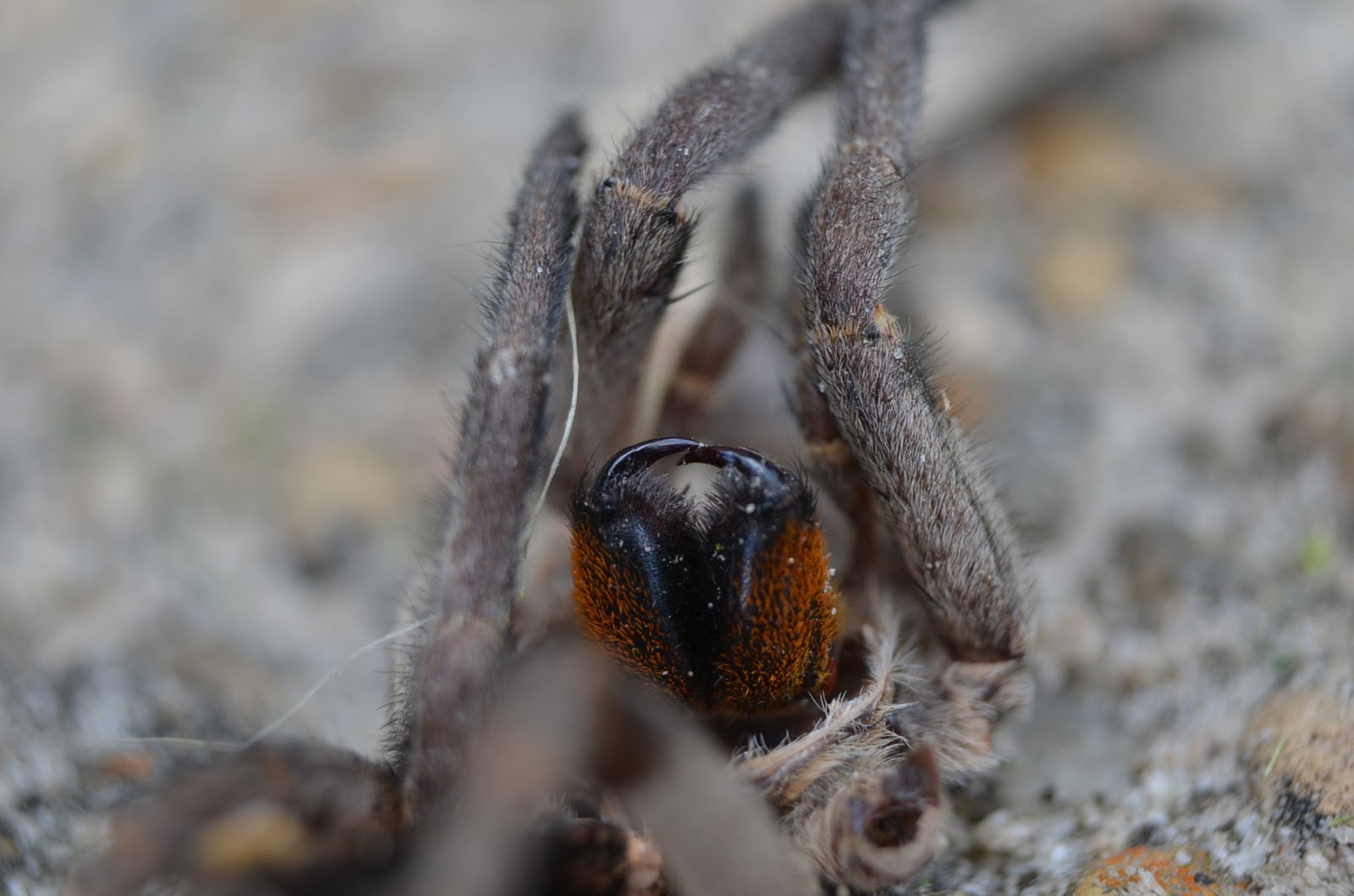
 I opened up the valve case that houses the inlet water valve to the camp house and was about to reach in to turn the water on when I saw something scurry. When most people see something scurry there’s an impulse to flee, but I have an insatiable curiosity to know what scurried.
 Lurking near the valve handle was a large wolf spider. In one corner was a hole about the size of a quarter and appeared to have been a part of a pine vole’s tunnel, which are abundant around here. The spider could have taken advantage of this to gain access to this hidden area. When I reached in to turn the valve it made no attempt to pounce, no attempt to bite. Not many people would reach in and place their hand near this spider much less any spider for that matter. Most folks are afraid simply due to ignorance. This is one of the main reason why I continually introduce my grand-daughter to wildlife so that she will grow up knowing that not all things outside are out to get you.
They are called “wolf” spiders not only because they’re hairy and stocky, but also because they use their quickness and agility to stalk their prey instead of building a web to capture it. They do have fangs, can bite and posses venom, but it is harmless to humans. They are beneficial in that they prey on insects that are pests.
A week or so later when I returned and opened the lid expecting to find the spider again, I instead found what I thought at first was the spider’s dead carcass, but on closer examination what I found was its exoskeleton following a molt.  As spiders grow they molt or shed their old smaller exoskeleton for a new larger one.
My other wolf spider related posts can be found here: (1)  (2)  (3) (4)

Share

Labels: , , ,

Thursday, August 04, 2011

Male Widow

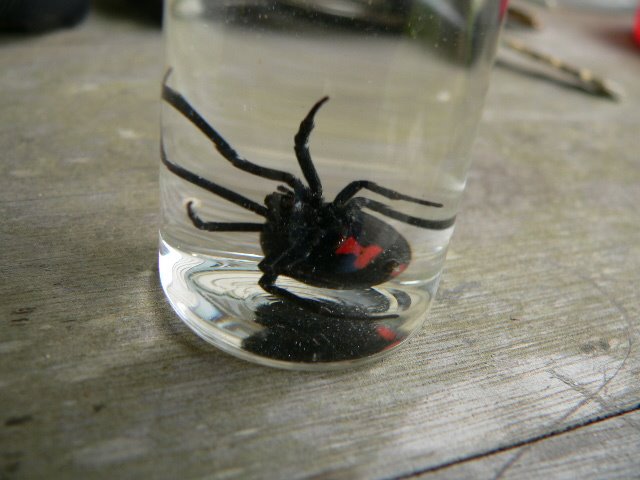
Creeping along on the outside wall of the house near the water faucet was a male black widow. I've found many females around here that I've written about before, (1), (2), but never a male. To tell you the truth I had no idea at the time what a male looked like. The female version though is pretty obvious with her large bulbous abdomen, long spindly legs and trademark red hourglass

The name “black widow” was derived from the idea that the female eats the male soon after they copulate. I’m finding out though that this is not always true. The female is unpredictable when it comes to “sexual cannibalism” of the male. Sometimes she eats him before copulating, sometimes after- because she's hungry. Most times though he leaves unharmed, and that's because most males mate with well-fed females more than ones that haven't eaten in a while, but how do they know the difference? Has something to do with the male sensing chemical and architectural cues in the female’s web that tells him if the she is ravenous or not. (3) All in all, I guess it just depends on what kinda mood she’s in.

Labels: , ,

Tuesday, March 01, 2011

Southern House Spider

I found this large spider strolling across the floor in the lab where I work and scooped it up into a cup to find that it was a female southern house spider (Kukulcanka hibernalis) also known as a "crevice weaver". First described in the mid 1800's by the French American arachnologist Nicholas Marcellus Hentz, it does have a menacing look to it, but will not bite unless its trapped.

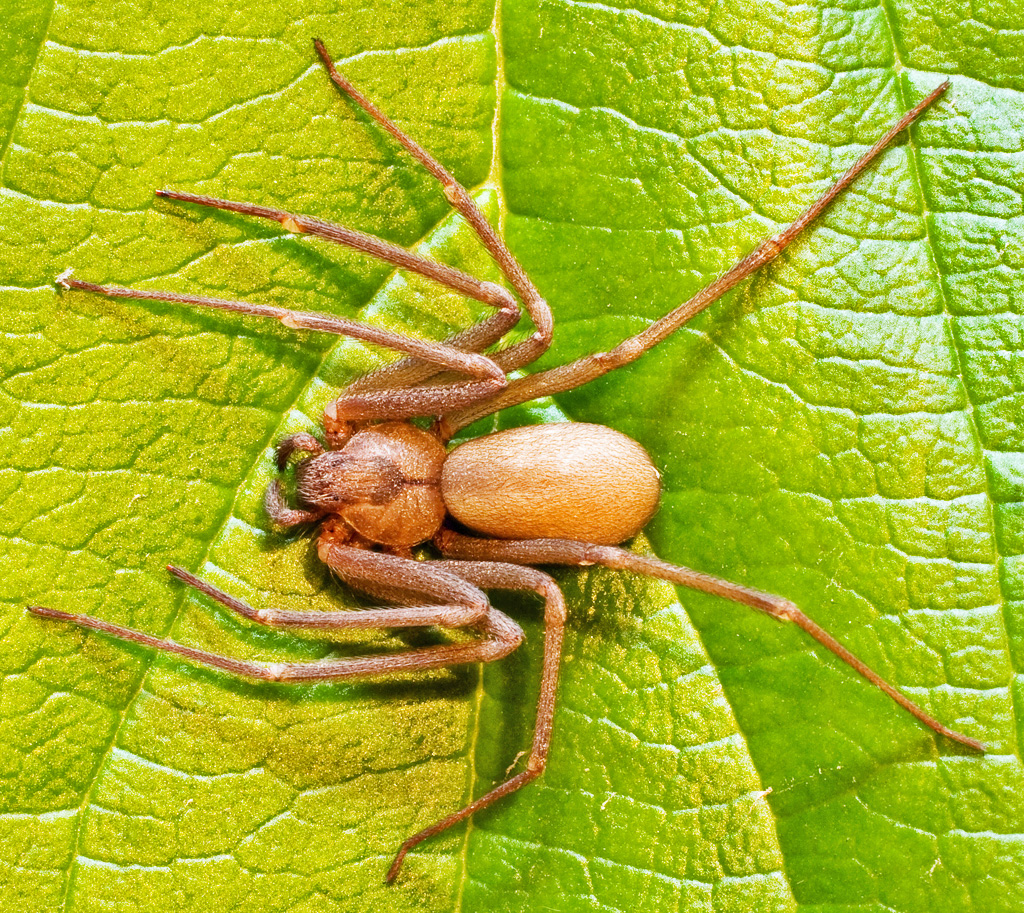
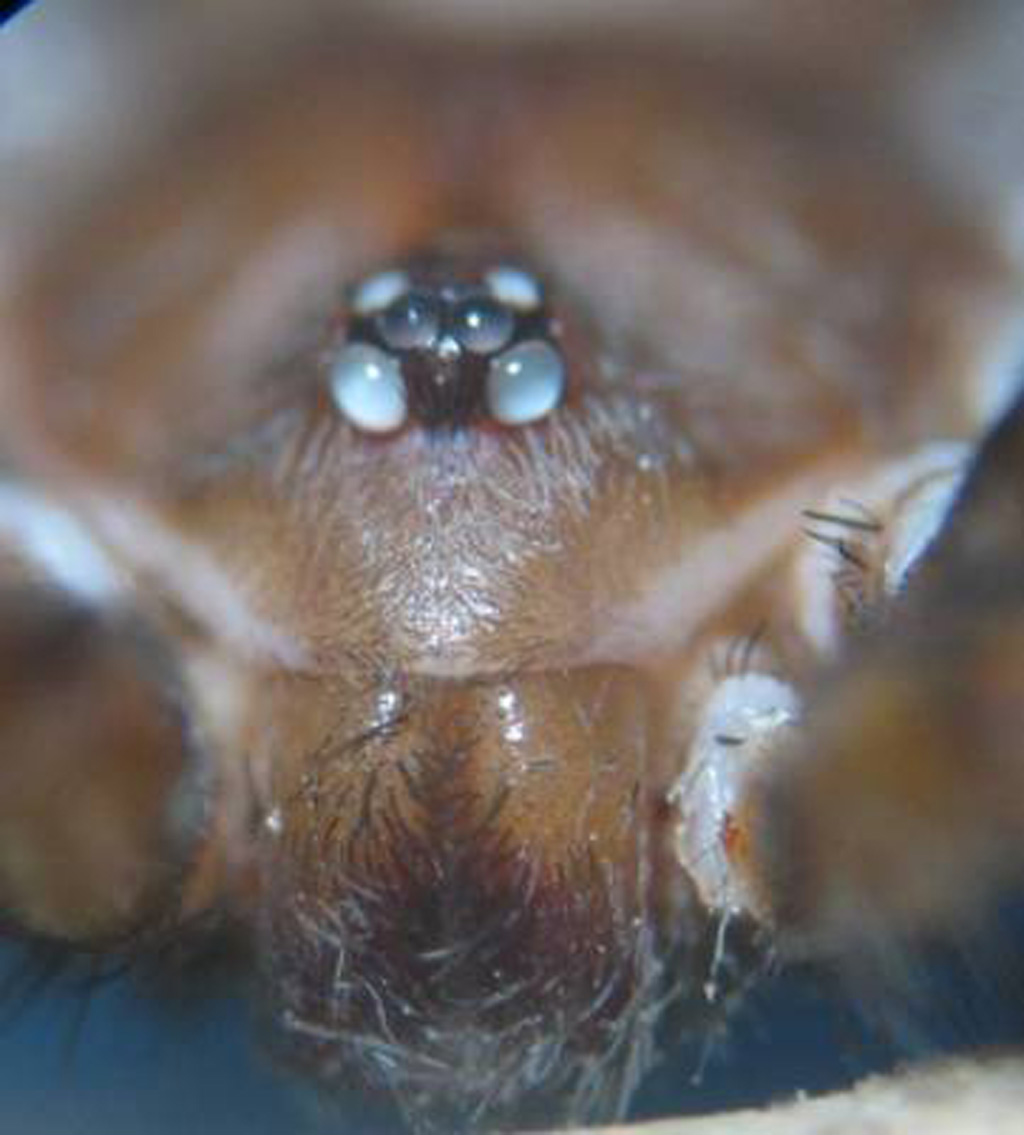
Some people mistaken the male for the brown recluse (Loxosceles reclusa) because of shape and color and due to the prominent groove down its thorax, which in combination with the dark area of the head behind its eyes, suggests the presence of a "fiddle" as found on the recluse. One difference between the two is eye arrangement. The recluse has three sets of two eyes that are in an "arc" arrangement, whereas the house spider has eight eyes grouped together. Also, the recluse got its name because it's "reclusive" meaning you usually do not see one scurrying across the floor. Because most of the people I work with are arachnophobes and would've squashed it in a instant, I decided to take it home and release it so it could live its life.

Labels: , , , ,

Thursday, July 01, 2010

Mysterious Orb

When I'm outdoors I always keep my eyes open for potential blog material. I work on being as observant as possible exploring every sound, every object at my feet, in the trees, in the water and in the air. Being this way has paid off time after time, leading me to discovering some particular feature of the vast thing we call nature.

Several days ago I was buttoning up our camp, preparing to leave when my eye caught an object on the ground. I think it was actually the color of the object that got my attention. It was a little bit smaller than a marble and was the color of patina. I picked it up and noticed that it was covered with tiny holes, as if something had chewed on it.

It looked really familiar to me and moments later I knew what I held in my hand- the egg sac of a wolf spider. Not long ago I had posted a blog entry about a wolf spider I had come across that was carrying one of these. Some spiders attach them to their web, but wolf spiders, which do not spin webs, carry their eggs sacs with them. The female lays hundreds of eggs, encases them in a round silk case, and then attaches it to her spinnerets . She will then carry it until, somehow, she knows they are ready to exit the silken incubating orb. Maybe she feels them moving inside.......

She will then chew holes in the egg sac allowing her offspring to escape. Once the spiderlings exit they immediately climb upon their mother's back where they will stay until their first molt.

Labels: , , , , ,

Wednesday, November 11, 2009

Arachnophobia

To someone who is not fond of spiders, this harmless, bulbous female orb weaver is pretty freaky looking. She decided to take up residence inside a playhouse that my grandkids frequent and this didn't go over well with everyone. To me it was pretty cool especially since Halloween was just around the corner, but needless to say my opinion didn't put smiles on any faces. So before she became what would resemble a Jackson Pollack painting I scooped up the little lady and relocated her away from the play area.


I'm never concerned about spiders unless of course it's poisonous (black widow, recluse) and even then I'm more than likely to transfer it off into the woods where they can do what they do. That's just the way I am and as I've said before- some folks think that's just strange....

Labels: , , , , ,

Friday, January 02, 2009

Harvestmen

Seeing a mass of harvestmen (aka “daddy longlegs”) would probably cause panic for anyone suffering from arachnophobia. I was removing a bbq pit from an old shed and upon opening it found a throng of harvestmen that was so massive it covered the entire inner surface of the pit’s lid. Realizing they were exposed they all began bobbing up and down giving them an even more creepy appearance. A little known fact though is that harvestmen are actually not true spiders. They fall in the order Opiliones, whereas spiders are in the order Araneae. They have eight legs, but are different from spiders in other ways.


~ The bodies of spiders have two sections- the abdomen and cephalothorax. Harvestmen have an oval-shaped body much like mites and ticks. There are two parts fused together giving the appearance of a single segment with no "waist".

~ Spiders have venom with which they inject their prey to immobilize them, but harvestmen do not. They do have fang-like mouthparts (chelicerae) and feed on insect eggs, decaying plant matter, aphids, caterpillars, flies, mites, earthworms, snails, and any decaying animal matter they come across.

~ Spiders have silk producing glands; Harvestmen do not produce silk and in turn no webs.

Harvestmen do perform one feat not done by true spiders- if attacked by a predator they can detach a wriggling leg much like geckos and lizards do with their tail in order to distract it while the harvestman escapes (Note the missing leg in the photo above). This can be a blessing and a curse though. The ejected leg does not regenerate like the afformentioned tails meaning each time it loses a leg in order to escape being eaten it becomes progressively handicapped.

So all of you arachophobes remember these guys are harmless, not really spiders and are pretty much nothing but legs. There's an old French peasant legend that states "the sighting of a harvestman in the evening hours is a good omen, a portent of good luck, and a symbol of hope."


Sources:

Harvestmen: The Biology of Opiliones. Glauco Machado & Gouzalo Giribet. Harvard University Press (c) 2007.

http://en.wikipedia.org/wiki/Harvestman

Labels: , ,

Wednesday, November 21, 2007

One Big Wolf Spider


As I leisurely urge the lawnmower across the rough hay something scurries ahead. My first impression was that I had distressed a small rodent, but upon closer inspection I find that it is one of the largest wolf spiders I’ve ever encountered. My first inclination is to grab it before it gets away, but remembered immediately that even though these spiders are not poisonous they can still bite. I hurriedly ran to the house, grabbed a peanut butter jar and luckly when I returned it was still there. I then placed it into a plastic bin that I had in order to photograph it.
As I nervously brought the lens of my Lumix as close as possible I couldn’t help but think it would at any moment pounce on my shaky hand. I know of many folk that would’ve stomped it into oblivion- just because. Little do they know that these wolf-like predators are not only harmless, but play an important role in keeping insect pests in check.
In order to get a sense of its enormity I placed my hand beneath it…..under the container of course :-)

Labels: ,

Saturday, October 27, 2007

Six-legged Spider


One of the differences between spiders and insects is that insects have six legs and spiders have eight. They belong to the class arachnida which includes mites, scorpions, and ticks. While hiking along a trail I came face to face with an unusual golden silk spider- one with only six legs. It more than likely lost two of its legs to a predator such as a bird. This handicap didn't seem at all to hinder its web building capabilities or its ability to go after prey as noted when I strummed its web. It moved just as creepy fast as an eight-legger. Just proves how insects as well as other animals adapt when faced with situations such as this. Rather than wither and die they learn to adjust.

Labels:

Monday, September 10, 2007

Wolf Spider


They're called "wolf" spiders for good reason. They are ground dwelling spiders that do not rely on a web for capturing food, but instead use their hunting skills to find and run down their prey like, well.....a wolf. This particular female looks as if she’s dragging a rock behind her, but is in fact an egg sac. After mating with a male the female lays her eggs, fertilizes them with the male’s sperm that has been stored in her body, and then builds a silken sac around them. She is very maternal and will protect the egg laden sac with her life. It will be carried from her spinneret for a week or two as they develop and then she’ll pierce the egg sac with her fangs allowing the young to escape. The spiderlings will then climb upon her back for a short period of time before dispersing to begin a life of their own.

Labels: ,

Friday, August 24, 2007

Spiders and Snakes

Spent a morning exploring a portion of Turkey Creek Trail with my brother and his son. As we hiked we found the trail to be shrouded with webs of golden silk and garden spiders. A person afflicted with arachnophobia would've gone off the deep end had they seen what we saw. They were everywhere, most smack in the middle of the trail and with me leading the way I ended up covered in spider's silk.
These large spiders can have an ominous appearance due to their size and they do have fangs, but they're basically harmless and are not poisonous. I lightly tapped an area of one of the webs and the spider raced to the very spot. Creepy.........

My brother was the snake magnet for the day spotting two. The first one moved away so quickly I was unable to catch or identify it. Its backside was mostly a brownish color with no discernible markings. We searched for several minutes around the brush it escaped into with no luck. The other was a nice diamond-backed water snake that was as thick as my forearm. If you've ever encountered one of these chunky snakes you know that they can be pretty aggressive when accosted. This particular one, often mistaken for a cottonmouth, has a habit of flaring its head out giving it a triangular or "poisonous snake" appearance.
It was lying motionless on the edge of some brush and was in the process of shedding its skin (ecdysis). I knew this due to its dull appearance and the fact that its eyes were opaque. During this time snakes are more vulnerable and aggressive due to their vision being impaired. Sensing our scent or vibration it began to retreat into the brush so I grabbed its tail and pulled into the open. As I did this I got "musked" which is a normal occurrence when handling most non-venomous snakes and is used as their first line of defense. Musk glands are located near the cloaca that spew the funk all over you when handling them and believe me it's not a very pleasant odor. I tried cleaning it off with anti-bacterial wipes, but the odor prevailed. As soon as it was entirely exposed it went on the defense rearing up to strike.......and strike it did hitting me twice in the leg. The speed of its strike was scary fast and solid. The first attempt just grazed me but the second time its teeth became hung up in the nylon fabric of my pants leg. Pulling back violently it released itself and prepared for another strike if needed. I checked my leg and found that it didn't connect. What a rush......to me anyway, but my brother almost had a stroke. He just knew it was poisonous.

NOTE: The focus of this hike was to get my nephew Garet "outside" to experience what is out there. To peak his interest in the wild things that make up the beauty of this planet. Kids his age nowadays are unfortunately more interested in other things such as video games, etc. and really have no idea what surrounds them. It is our duty as adults to get our children and grandchildren back to nature for they are the future protectors of what, unfortunately, is headed for a collision course with disaster. They are our only hope.

Labels: , ,

Sunday, December 31, 2006

Seeing Double


A stiff breeze cuts low across the hayfield as I march towards the pineywoods. There on one thick waving strand of hay I see something. Hanging midways up the strand is what appears to be two pretty good sized wolf spiders, both suspended motionless except for when the breeze touches them. I kneel down for a closer look only to find that it's not two spiders,but one. The other "spider" was nothing more than the molted skin of the other....an exact replica.

Spiders have no inner skeletons, but instead have what is known as an exoskeleton or outer skeleton. They molt or shed (ecdysis) this exoskeleton as they grow doing this up to a dozen times before they reach maturity. The shed exoskeleton is replaced by a fresh one which in the beginning is soft and takes awhile to harden. The spider must remain still during this time which makes it vulnerable to both predators and the elements. To watch a tarantula molt go here.

Labels: , ,

Sunday, September 17, 2006

Mud Dauber Tube Cache

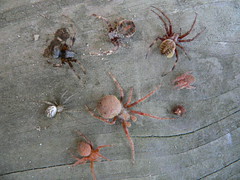
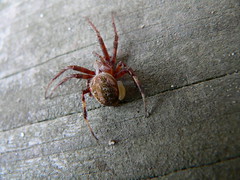
I bought a storage shed for the camp to keep odds and ends in and while setting up my ladder to do a little caulking I found the nest tube of a mud-dauber securely glued to the top step. I was moving the ladder in order to photograph the single tube when I bumped it on a corner of the shed and broke it open. Inside revealed what the dauber had stored for its future progeny. With a pair of tweezers I began delicately removing one spider after another. I was amazed at how many were crammed in such a small tube. I found 5 different species, 8 spiders in all. They're not dead but in fact paralyzed by the venom of the adult dauber so they'll stay fresh.
P1060777
If you'll notice in the second picture there is a mud-dauber larva feeding on one of the spiders. Amazing....
P1060773

Labels: ,

Thursday, September 14, 2006

Black Widow - Part II


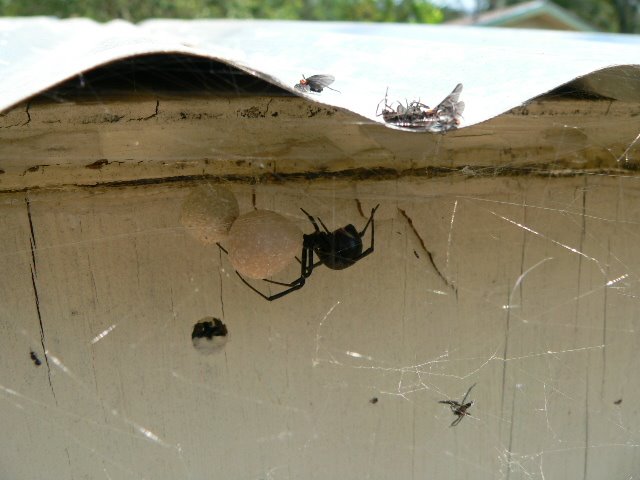
Just when I thought I ridded the inside of the pump house of black widows I find another one with two egg sacs this time on the outside just underneath the overhang of the metal roof. As I approached she scurried into one of the nooks formed by the corrugated roof leaving the egg sacs behind. Her cobweb angles downward towards the ground and doesn't amount to much and is not as intricate as other spiders- kinda shabby looking, but it serves its purpose trapping insects for her. When I tapped the tin roof near the egg sacs she rushed to them with "creepy" speed raising the hackles on my neck. I took photo after photo reminding myself just how close I was to much pain.

Labels: ,

Saturday, July 29, 2006

Yellow Death


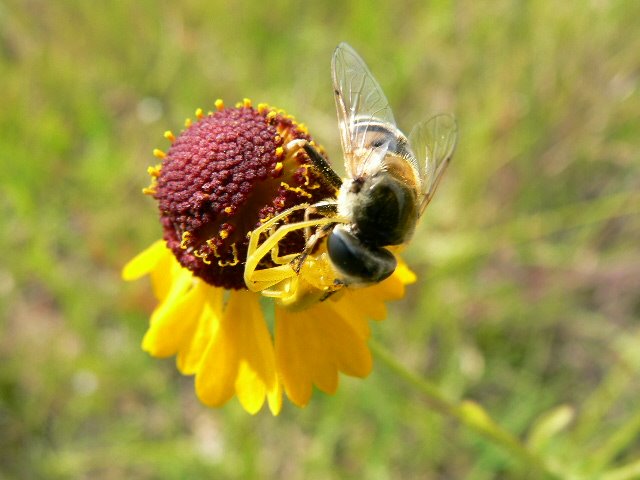
Hungry predators can be hiding right under your nose. Tell that to the bee fly. The only reason I saw what was occuring here is because of unnatural movements made by the bee fly. With wings abuzzing it appeared as if was hovering upside down. As I knelt down for a closer look I saw what was happening. The beefly wasn't hovering upside down as I thought but was actually in the clutches of a goldenrod spider (Misumenopes vatia). It blended so well with the petals of the flower that I (along with the bee fly) was unaware it was there.

Goldenrod spiders do not build webs, but lie in wait. Useing the attractiveness of the flower as bait, the spider blends in amongst the petals until an unwary insect comes along. It is then grabbed, immobilizing by venom, and then its insides sucked dry. Not a pleasant way to go. Click on the photos for a closer look.

Labels: ,

Friday, July 07, 2006

Bad Things Hide in Dark Places


Bad things can hide in dark places. Places where you sometimes have to place your hand. As I reached inside the small wooden pumphouse that shields our water pump from the elements, my eye catches a dark spot near the discharge valve I'm trying to open. I pull back and shine a flashlight into the shed to find that the dark spot is in fact a large black widow spider (Latrodectus mactans). As the light passes over it I see the trademark red hourglass found only on the larger female. Black widows are "cobweb" builders forming a jumble of crisscrossed web with no discernable pattern. Looking at her you can't tell if she's asleep or on full alert. I take a small stick, reach inside and gently tap a strand of her web. She bounds to the spot I touched with a quickness that makes me shudder. Had it been my hand that had brushed the web I would have more than likely felt the sting of her bite and later the excruciating pain of the neurotoxic venom she would've injected. From now on I'll make it a habit to look before I reach into dark places.

Labels: ,

Web Counter
Online Schools